

Only One Burial Flag: Folded Flag Etiquette for Families
A folded U.S. flag should always show only the blue field of stars, arranged in a triangle with no red or white stripe visible, and it belongs indoors in a proper case or shadow box, never flown outdoors. The presentation follows a set script from the honor guard or funeral director, and only one burial flag is issued per eligible veteran. Beyond that, most of what people assume to be federal law is actually tradition, and knowing the difference changes how you display, preserve, and eventually retire the flag.
TL;DR:
- Burial flags should only show the blue stars side when folded and are meant to be displayed indoors in a case or shadow box, not flown outside.
- Proper folding involves a specific sequence of lengthwise and triangle folds, with a final tightly-folded triangle showing only stars, and it must never touch the ground during the process.
- The presentation script follows a formal hierarchy of recipients, with families needing to decide who receives the flag before the service, as only one flag is issued per veteran.
- Proper display cases include triangle or shadow box types, with UV protection, and long-term preservation is best achieved by careful handling and avoiding direct sunlight or heat.
- The Flag Code emphasizes respect and tradition rather than strict law, with the main legal requirements being no ground contact and proper retirement by burning when unfit for display.
Table of Contents
- How to Fold the U.S. Flag Correctly
- What Do You Say When Presenting a Folded Flag?
- Choosing a Display Case and Keeping the Flag Safe
- What the Flag Code Actually Requires vs. What’s Tradition
- When to Retire a Burial Flag and How to Do It Respectfully
- Common Mistakes Families Make with a Folded Flag
- How Etiquette Differs Across Military Branches, VSOs, and Civilian Settings
- Are There Legal Restrictions on Displaying a Folded Flag?
- A Veteran-Community Take on Tasteful Memorial Display
- Honoring Veterans with Warbeard Project’s Memorial-Ready Apparel
- Sources
- FAQ
How to Fold the U.S. Flag Correctly
Two people fold a burial flag, standing about six feet apart and holding the fabric taut at chest height so it never sags toward the ground. This isn’t ceremony for ceremony’s sake. A flag that touches the floor during folding technically violates the Flag Code’s respect provisions, and a taut fold also produces cleaner, sharper triangles.
The sequence goes like this:
- Fold the flag in half lengthwise, stripe side over the blue union.
- Fold it in half lengthwise again, so only the blue field with stars shows on the outside.
- Starting from the striped end (opposite the union), fold the bottom corner up to meet the top edge, forming the first triangle.
- Continue folding triangle over triangle, working up the length of the flag, alternating direction with each fold.
- Repeat until the entire flag is folded into a triangular shape, with roughly a dozen to slightly more folds depending on flag size.
- Tuck any remaining fabric into the folds so the final shape shows a clean, tight triangle with only stars visible, no white or red edge peeking out.
For a standard 5 by 9.5 foot VA-issued interment flag, this produces a compact triangular bundle small enough to fit in a standard display case. The final fold should sit flat, with the blue field completely covering any seam or loose corner.
Pro Tip: If you’re folding a flag for long-term preservation rather than immediate ceremonial use, wear clean cotton gloves. Skin oils can leave faint stains on flag fabric over years of storage, especially on older cotton or wool flags.
Never rush the final tuck. A loose corner is the most common flaw honor guards catch during inspection, and it’s an easy fix if you catch it before the flag goes into its case.

What Do You Say When Presenting a Folded Flag?
The presentation moment carries as much weight as the fold itself, and it follows a recognizable script whether an honor guard or a funeral director delivers it.
The full military version, used at services with honor guard participation, reads close to: “On behalf of the President of the United States, the [branch of service], and a grateful nation, please accept this flag as a symbol of appreciation for your loved one’s honorable and faithful service.” Funeral directors, who often step in when an honor guard isn’t available, tend to use a shortened version that keeps the sentiment but drops the formal preamble, according to American Legion flag guidance.
Recipient order follows a consistent hierarchy:
- Surviving spouse, if one exists
- Eldest child, if there’s no surviving spouse
- Parents, in the absence of a spouse or children
- Next of kin, following standard succession when no immediate family survives
Because the VA issues only one burial flag per eligible veteran, families need to settle on the intended recipient before the service, not during it. There’s no second flag if two family members both expect to receive one.
Families can request variations. Religious language, a shorter delivery, or a specific branch reference are all reasonable asks, and presentation logistics typically fall to the funeral director when no honor guard is assigned. Ask in advance, not at the graveside. Funeral staff generally welcome the direction since it removes guesswork on their end too.
Choosing a Display Case and Keeping the Flag Safe
Once the flag is folded and presented, the display case matters more than most families expect. Two main options exist: a triangle case, which shows only the folded shape, or a shadow box, which adds room for medals, photos, or a nameplate alongside the flag.
- Triangle cases fit the standard burial flag fold closely and work well for a minimalist wall or shelf display.
- Shadow boxes accommodate memorabilia but need more wall space and a sturdier mount.
- Wall-mounted cases should be hung with the point of the triangle facing up.
- Tabletop or shelf displays should orient the point toward the viewer, with the star field facing outward either way.
Environmental damage is the real threat to a preserved flag, and it happens slowly enough that families rarely notice until the fading is obvious. Direct sunlight, fluorescent lighting, and placement near heat vents or exterior walls all accelerate fiber breakdown and color loss. UV-filtering glazing on the case glass, a stable room away from temperature swings, and avoiding exterior walls or the space above a fireplace all help slow that damage.
Statistic Callout: The VA replaces zero lost or damaged burial flags beyond the original issue. One flag per eligible veteran, full stop. That policy alone is the strongest argument for taking preservation seriously from day one.
Conservators sometimes recommend skipping the permanent triangular fold altogether for flags intended purely for archival storage rather than display, rolling the fabric instead around an acid-free tube with tissue between layers to avoid permanent creasing. This matters most for flags with historical or family significance beyond a single service, where fiber stress over decades becomes a real concern. If you’re displaying the flag, the fold stays. If you’re storing a second flag or an heirloom piece long-term, rolling protects the fibers better.
Heavier shadow boxes need two wall anchors, not one, especially in homes with drywall rather than solid plaster. A single anchor point on a box holding medals and glass is asking for trouble.
What the Flag Code Actually Requires vs. What’s Tradition
The U.S. Flag Code is real federal text, but it functions more as a statement of etiquette than enforceable law for most everyday violations. Here’s the actual breakdown:
- Legally described: the flag should never touch the ground, floor, or water, and should not be used as clothing, bedding, or drapery.
- Legally described: when a flag becomes unfit for display, it should be destroyed in a dignified manner, preferably by burning.
- Legally described: display position rules require the union uppermost and to the flag’s own right when shown flat, per Title 4’s position and manner provisions.
- Traditional, not codified: the 13-fold recitation, where each fold is assigned a specific meaning, is a custom that grew up around military and veteran ceremonies, not a Flag Code requirement.
- Traditional, not codified: the triangular “cocked hat” shape itself references Revolutionary War-era headwear, a piece of cultural symbolism rather than statute.
Most Flag Code provisions carry no criminal penalty for private citizens. It’s a framework of respect, not a ticketing system, which is exactly why families have more flexibility on wording and ceremony than they often assume.
When to Retire a Burial Flag and How to Do It Respectfully
A flag that’s torn, badly faded, or permanently stained has reached the point where display no longer honors it. The Flag Code calls for retirement by burning when a flag is no longer fit for display, done in a dignified, private, or ceremonial setting.
- Rips, frayed edges, or holes that can’t be repaired without altering the shape
- Fading severe enough that the stripe colors have shifted or the blue field has grayed noticeably
- Stains from water, smoke, or mildew that resist cleaning
Many American Legion posts, VFW chapters, and Boy Scout troops hold organized flag retirement ceremonies and will accept a worn flag for respectful disposal, even one that isn’t yours personally. Since the VA won’t reissue a lost or destroyed burial flag, retirement should be the last resort for a badly damaged flag, not a convenient way to skip preservation.
Common Mistakes Families Make with a Folded Flag
Most errors are fixable in minutes if you catch them early.
- Trying to fly a burial-sized flag outdoors on a pole. Burial flags are ceremonial, not weatherproof outdoor flags, and belong indoors in a case.
- Forcing a folded flag into an undersized case, which crushes the fold and can leave the star field visibly off-center.
- Assuming brief ground contact means automatic retirement. Pick the flag up immediately and inspect for damage. A momentary touch during handling doesn’t require destroying the flag.
- Displaying the case near a heat vent, fireplace, or direct window light. Move it to a stable interior wall with even, indirect lighting.
For related display basics beyond the folded flag itself, common U.S. flag display mistakes cover the outdoor and pole-mounted side of the same etiquette.
How Etiquette Differs Across Military Branches, VSOs, and Civilian Settings
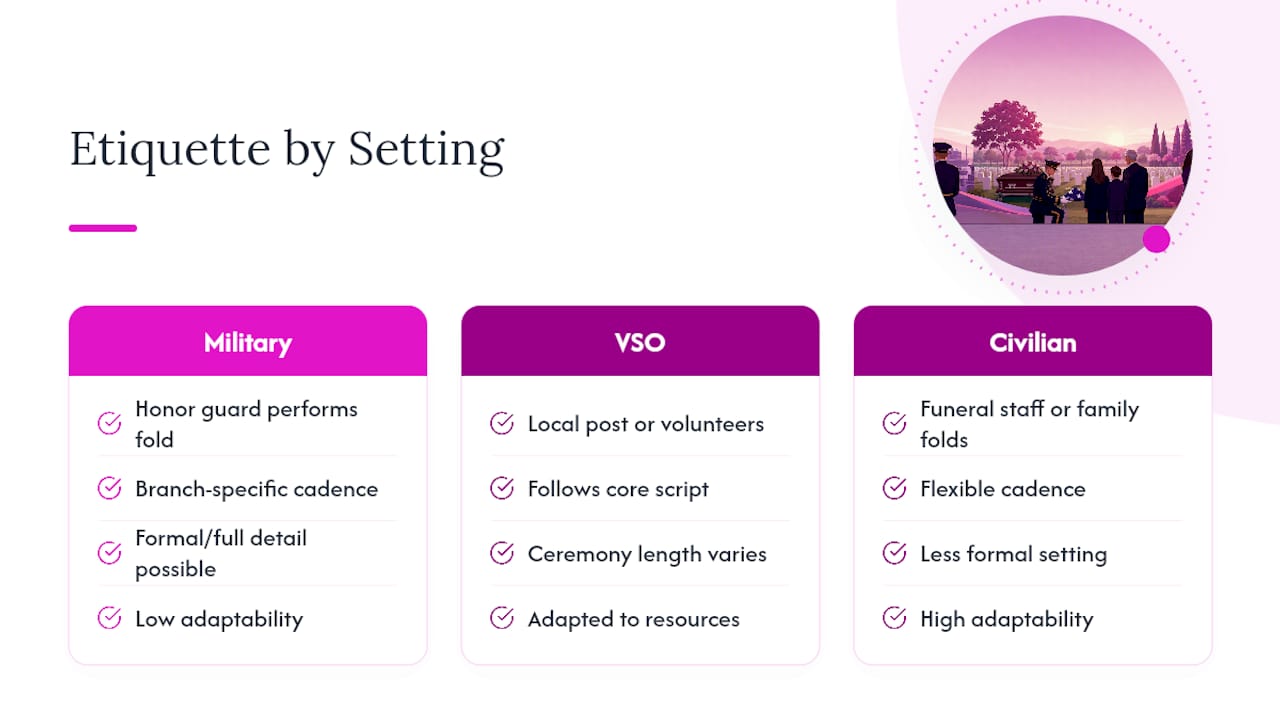
Each branch of the military maintains its own honor guard traditions, and small variations show up in cadence, wording, and who physically performs the fold. Army and Marine Corps honor guards, for instance, often incorporate slightly different verbal cues during the fold sequence than Navy or Air Force teams, though the finished triangular result looks identical across branches.
Veterans service organizations, including the American Legion and VFW, generally follow the same core presentation script but adapt ceremony length and setting based on chapter resources and family requests. A rural VFW post handling a graveside service with volunteer honor guard members may run a simpler version than a national cemetery with a full military detail.
Civilian and family-led services carry the most flexibility. Without an honor guard, a funeral director or family member performs the fold and presentation, and there’s no requirement to replicate military cadence exactly. What stays consistent everywhere is the core respect standard: correct fold, stars outward, careful handling, and a script that acknowledges the recipient’s loss. The formality changes with the setting. The underlying etiquette doesn’t.
Families planning a service without built-in honor guard support sometimes lean on funeral home staff or nearby veteran volunteers, and resources like funeral planning guidance can help coordinate those details ahead of the service date.
Are There Legal Restrictions on Displaying a Folded Flag?
Displaying a folded flag at home carries almost no legal risk under federal law. The Flag Code sets expectations, not enforceable restrictions, for private citizens displaying flags in their own homes or on personal property.
Where legal considerations do apply more concretely: commercial use of flag imagery, alteration of a flag for advertising purposes, and certain state-level statutes around flag desecration that vary in enforcement and have faced First Amendment challenges in court. None of that touches a family quietly displaying a burial flag in a case on a living room wall.
The one area worth real attention is the VA’s replacement policy. Since only one burial flag is issued per eligible veteran, there’s no legal mechanism to request a second one if the original is lost, stolen, or destroyed beyond repair. That’s a policy limit, not a criminal law, but it carries permanent consequences for a family that treats the flag casually.
Homeowners associations occasionally introduce their own flag display rules for exterior flagpoles, but those don’t extend to indoor memorial displays like a cased burial flag. If you’re ever unsure whether a specific display choice crosses a line, the primary sources, Title 4 and VA guidance, settle the question faster than any secondhand advice.
A Veteran-Community Take on Tasteful Memorial Display
Families often over-decorate a shadow box, crowding it with every medal, photo, and patch available. Simpler reads as more respectful. A folded flag, one small unit insignia, a nameplate, maybe a single medal, says more than a case packed edge to edge.
Skip anything that competes visually with the star field. If you’re planning a service and want ceremony support, local veterans organizations and VA offices exist specifically to help families get this right.
— Ian
Honoring Veterans with Warbeard Project’s Memorial-Ready Apparel
Some apparel brands offer options for moments where a flag alone doesn’t say everything a family or a fellow veteran wants to express.

For a service or wake, understated apparel works best alongside the flag itself. The VietNam Classic tee and the Special Edition VAWP2607 Unisex classic tee offer tribute designs without competing with the ceremony’s focus. For colder services, the Bear Beast Unisex Hoodie from the BEAST Collection covers practical warmth. Family members looking for something quieter afterward often reach for comfort pieces like the OG Logo Women’s pajama shorts or the matching OG Logo Women’s pajama pants. If you want to browse the full range, including T-shirts, hoodies, women’s wear, and more, the collection page covers every category from apparel to home decor.
None of this replaces the flag or its case. It’s a way to carry the same respect into what you wear before and after the service. Browse the collection and pick a piece that fits the occasion.
Sources
- 4 U.S. Code § 8 - Respect for flag
- Burial flags - U.S. Department of Veterans Affairs
- Meaning behind folding the American flag - National Air and Space Museum
- §7. Position and manner of display - U.S. Code (govinfo)
FAQ
How Should a Folded American Flag Be Displayed?
Display it indoors in a triangle case or shadow box with the blue star field facing outward, never a stripe. Wall-mounted cases should have the triangle’s point facing up, while shelf or tabletop cases should have the point facing toward the viewer.
What Do You Say When Presenting a Folded Flag?
The traditional script says: “On behalf of the President of the United States, the [branch of service], and a grateful nation, please accept this flag as a symbol of appreciation for your loved one’s honorable and faithful service.” Funeral directors often use a shortened version when an honor guard isn’t present, according to American Legion guidance.
What Are the Rules of Flag Etiquette?
Core rules include never letting the flag touch the ground, displaying the union uppermost and to its own right when shown flat, retiring worn flags by burning, and giving the U.S. flag the position of honor among other flags, all outlined in Title 4 of the U.S. Code. Beyond these, many widely repeated “rules” like the 13-fold recitation are tradition rather than statute.
What Are the Main Rules for Displaying the U.S. Flag?
The flag should never touch the ground, should be displayed with the union in the position of honor, should never be used as clothing or drapery, and should be retired respectfully once it’s no longer fit for display. These come directly from Flag Code provisions rather than local custom.
Does the VA Replace a Lost or Damaged Burial Flag?
No. The VA issues only one burial flag per eligible veteran and does not reissue a replacement if it’s lost, stolen, or destroyed, according to VA burial flag policy. That policy is the main reason preservation and careful case selection matter so much.