

Avoid 3 Flag Mistakes Veterans Spot Instantly: U.S. Display Rules
The U.S. Flag Code (Title 4 of the U.S. Code) sets the advisory rules for displaying and handling the American flag. Three things matter most: display it sunrise to sunset unless it’s properly illuminated after dark, keep the union (the blue field of stars) uppermost and to the observer’s left, and never let the flag touch the ground, serve as clothing, or carry an ad. Federal law does not carry criminal penalties for violations, though some states have their own statutes.
TL;DR:
- Proper flag illumination at night requires the flag to be the focal point of a light source, not just nearby ambient lighting.
- The union should always be positioned uppermost and to the observer’s left, whether displayed flat, on crossed staffs, or draped from a window.
- Flying the flag in poor weather or when not rated for severe conditions damages it quickly, so it should be taken down during storms or after heavy winds.
- Federal and state authorities determine the rules for half-staff observances, and it is crucial to follow official proclamations precisely.
- The flag should be retired respectfully by burning when it is worn or damaged, or handed over to authorized organizations for proper disposal.
Table of Contents
- What American Flag Display Rules Say About Timing
- Position and Manner of Display: Getting the Union Right
- Prohibitions and Proper Conduct During Ceremonies
- Half-Staff Protocols: Who Decides and For How Long
- How to Retire a Worn or Damaged Flag
- Displaying the Flag With Other Flags, on Floats, and on Vehicles
- Flag Etiquette and Apparel: What Veterans Want You to Know
- How to Fold the American Flag Properly
- Flag Protocols During Mourning and National Emergencies
- Why This Guide Exists: A Veteran-Focused Perspective
- Show Your Patriotism the Right Way
- Where to Check the Official Rules Yourself
- Sources
What American Flag Display Rules Say About Timing
The standard rule is simple: the flag is customarily displayed from sunrise to sunset. 4 U.S.C. § 6 sets that as the customary window, but it also allows 24 hour display when the flag is properly illuminated during darkness. “Properly illuminated” means the flag itself is the visible focal point of a light source, not just sitting somewhere near a porch bulb that happens to catch a corner of it.
That distinction trips up a lot of homeowners. A single spotlight aimed at your flagpole so the flag stands out clearly at night satisfies the rule. A string of patio lights strung nearby that leaves the flag in shadow does not.
The Flag Code also calls out specific days when display is especially encouraged, even though flying the flag daily is always appropriate:
- New Year’s Day, Memorial Day, Flag Day (June 14), and Independence Day
- Veterans Day, Labor Day, and Memorial Day (half-staff until noon, then raised to full staff)
- Election Days and the opening of school on school days, where practical
- Any day proclaimed by the President of the United States
Weather is where a lot of well-meaning flag owners get it wrong. Traditional cotton flags degrade fast in rain, wind, and snow, and the Flag Code has always assumed the flag would be brought in during inclement weather. All-weather flags made from nylon or heavy polyester are built to withstand the elements and are the better choice if you plan to fly your flag continuously rather than raising and lowering it daily.
Pro Tip: If you travel often or can’t commit to a daily raise-and-lower routine, invest in a solar-powered flagpole light and an all-weather nylon flag. That combination lets you comply with the illumination rule without babysitting the pole every evening.
If a storm rolls in and your flag isn’t rated for severe weather, bring it down. Leaving a standard cotton or blended flag flapping through a thunderstorm is one of the fastest ways to shred a flag you’ll end up needing to retire early.
Position and Manner of Display: Getting the Union Right
Union placement is the single most misunderstood rule in the entire code, and 4 U.S.C. § 7 spells it out precisely for nearly every scenario you’ll encounter.
- Wall or flat surface display. The union goes uppermost and to the flag’s own right, which means it appears to the observer’s left when you’re facing it.
- Displayed with another flag on crossed staffs. The U.S. flag’s staff crosses in front of the other flag’s staff, and its union stays to the flag’s own right.
- Displayed from a window. The union should be placed at the peak of the staff unless the flag is draped from a windowsill, in which case the union still goes to the observer’s left.
- Hoisting and lowering. Raise the flag briskly to the top of the pole. Lower it slowly and ceremoniously. Fast up, slow down, every single time.
- Half staff sequence. Raise the flag to the peak first, hold it there briefly, then lower it to the half staff position. At the end of the day, raise it back to the peak before lowering it fully.
- In a procession or parade. The flag marches at the marching right or, if a line of other flags is carried, at the front and center of that line.
- Projecting from a building. A flag on a staff extending from a windowsill, balcony, or front of a building flies with the union farthest from the building itself.
- Suspended over a street. When hung vertically across a street, the union points north on an east west street and east on a north south street.
The “observer’s left” rule confuses people because it sounds backward. Stand in front of a flag display and look at it the way you’d read a page. The stars belong on your left, the stripes trailing off to your right. If you’re arranging a flag on a casket, a stage backdrop, or a wall-mounted display case, get this wrong and it’s usually the first thing a veteran in the room will notice.
Prohibitions and Proper Conduct During Ceremonies
4 U.S.C. § 8 lays out the behaviors the Flag Code treats as disrespectful, and most of them come down to a single idea: the flag is never a prop, a costume, or a marketing tool.
- Never let the flag touch the ground or floor.
- Never use it as apparel, a costume, athletic uniform, or gym gear.
- Never use it as bedding, drapery, or a tablecloth.
- Never print anything on it for temporary use, and never use it on disposable items meant to be discarded, like paper napkins or cardboard.
- Never draw, mark, or attach lettering, insignia, or designs of any kind onto the flag itself.
- Never carry it flat or horizontally. It should always be free to fly.
During the raising, lowering, or passing of the flag, everyone present should stop, face the flag, and place their right hand over their heart. Those in uniform render the military salute. Veterans not in uniform are also entitled to render the salute as a mark of respect, a practice widely recognized by The American Legion and other veteran organizations.
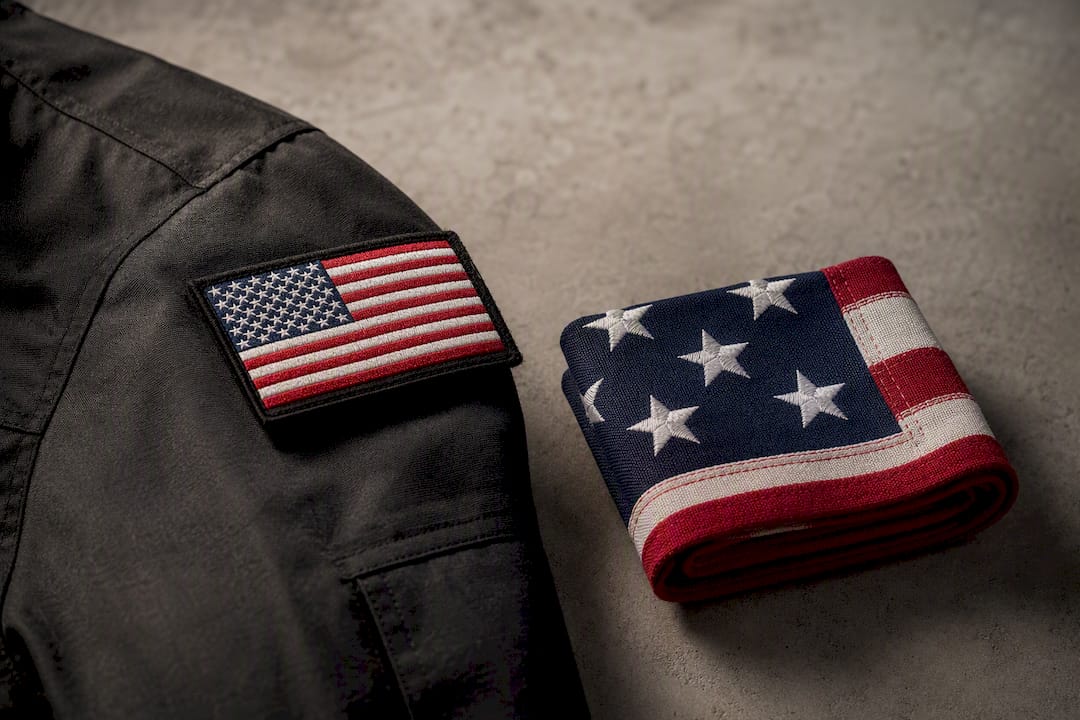
Pro Tip: A flag patch on a military uniform, first responder gear, or an authorized organization’s jacket is not the same as wearing the flag as clothing. The Flag Code’s ban applies to using the actual flag as a garment, not to small embroidered patches or emblems that represent it.
That distinction matters for anyone trying to figure out where the line sits between honoring the flag and violating its etiquette. A patch sewn onto a shoulder is different from a flag draped like a cape.
Half-Staff Protocols: Who Decides and For How Long
Flying the flag at half staff is a formal signal of mourning, and the authority to order it is narrower than most people assume. The President of the United States can order half-staff observance nationwide. Governors can order it for their own states, and mayors typically have authority over municipal flags. Following the correct proclamation, rather than guessing, is the actual rule here.
- 30 days from the death of a President or former President
- 10 days from the death of the Vice President, Chief Justice, or Speaker of the House
- From the death until interment for other designated federal officials
- Memorial Day, from sunrise until noon only, then raised to full staff for the rest of the day
The sequence for setting the flag at half staff isn’t optional. Raise the flag briskly to the very top of the pole first, pause, then lower it slowly to the half staff position. At the close of the day, reverse that sequence: raise it back to the peak, hold, then lower it completely for the night. Skipping the peak step and just stopping partway up the pole is a common error that misses the ceremonial point entirely.
If you’re not sure whether a half-staff order applies to you, check your state government’s website or Usa before adjusting your pole. State and local proclamations don’t always match federal ones, and flying at full staff while your neighbor’s flag sits at half staff because of a local order is an easy, avoidable mistake.
How to Retire a Worn or Damaged Flag
A flag that’s frayed, torn, faded beyond recognition, or otherwise no longer fit to serve as a fitting emblem should be retired, not thrown in the trash. The American Legion and VA both recommend retirement by burning in a dignified, controlled ceremony.
- Fold the flag properly before the ceremony begins.
- Conduct the burning in a private, respectful setting, ideally away from young children, and follow local fire codes and burn ordinances.
- Place the flag on the fire and allow it to burn completely, then bury or scatter the ashes.
- If burning isn’t practical or legal in your area, contact a local VFW post, American Legion chapter, or Boy Scouts troop. Many run scheduled flag retirement ceremonies and collection boxes at their locations.
- Some municipal offices and post offices also accept worn flags for proper disposal. A quick call to your city hall will usually tell you whether that service exists near you.
Displaying the Flag With Other Flags, on Floats, and on Vehicles
When the American flag appears alongside other flags, it takes precedence every time. 4 U.S.C. § 7 is explicit: it flies at the peak, never below another flag, and never to the right of a flag of equal or lesser rank when grouped on the same halyard.
- On separate staffs of the same height, the U.S. flag goes to its own right, which appears leftmost to the viewer.
- State, city, and organizational flags fly below the U.S. flag or on a shorter staff when grouped together.
- Foreign national flags, during peacetime, are flown on separate staffs of equal height, with no flag positioned above another.
For parade floats, the flag should be displayed on a staff, never draped flat across the hood or side panels of a vehicle. If you’re decorating a car or truck for a parade or a patriotic event, mount it in a clamp-style flag holder rather than taping or draping it directly onto the body, similar to respectful style seen on the Gulf of America Hat Embroidered Patch Mesh Back Trucker Hat that honors patriotic display.
On indoor platforms and speaker podiums, the flag of honor stands to the speaker’s own right as they face the audience, which puts it stage right and typically appears to the audience’s left. Any other flags present, including state or organizational banners, are arranged to the speaker’s left.
Flag Etiquette and Apparel: What Veterans Want You to Know
Veteran-themed apparel lives in the space the Flag Code was written to protect. The Code’s ban on wearing the flag as clothing is specific: it targets garments made from an actual flag, or printed to look like one, worn as a costume or throwaway item. It does not ban embroidered patches on authorized uniforms, unit insignia, or apparel that references the flag respectfully without reproducing it as a wearable version of the actual flag.
That distinction guides how we think about design. A full-flag print slapped onto a cheap tank top meant for a single wear at a barbecue treats a national symbol like a costume. A tastefully rendered stars-and-stripes motif, a unit patch, or a tribute design built to last years in someone’s closet treats it like what it is.
- Choose patches, tributes, and motifs over literal full-flag garments when shopping for patriotic apparel.
- Look for pieces built for years of wear, not a single Fourth of July cookout.
- Check that any flag-adjacent design avoids placement on disposable or single-use items.
- When in doubt about a design’s respectfulness, ask whether it would look appropriate framed on a wall, not just worn once and discarded.
Pro Tip: If you’re shopping for a gift for a veteran or active-duty family member, a piece with a respectful flag motif or unit tribute tends to land better than anything printed with the literal flag pattern. It reads as tribute, not costume.
How to Fold the American Flag Properly
The 13-fold method is the standard ceremonial technique used at military funerals, retirement ceremonies, and by most veteran organizations, and it turns the flag into a triangular shape resembling a tricorn hat, with only the blue union visible on the outside.
Start by folding the flag in half lengthwise twice, so the union rests on top and the stripes are hidden inside. Beginning at the striped end, fold the corner into a triangle so the outer edge meets the top edge, forming the first triangular fold. Continue folding the flag in this triangular pattern, edge over edge, working your way down the entire length of the flag. Each fold should be crisp and tight against the previous one.
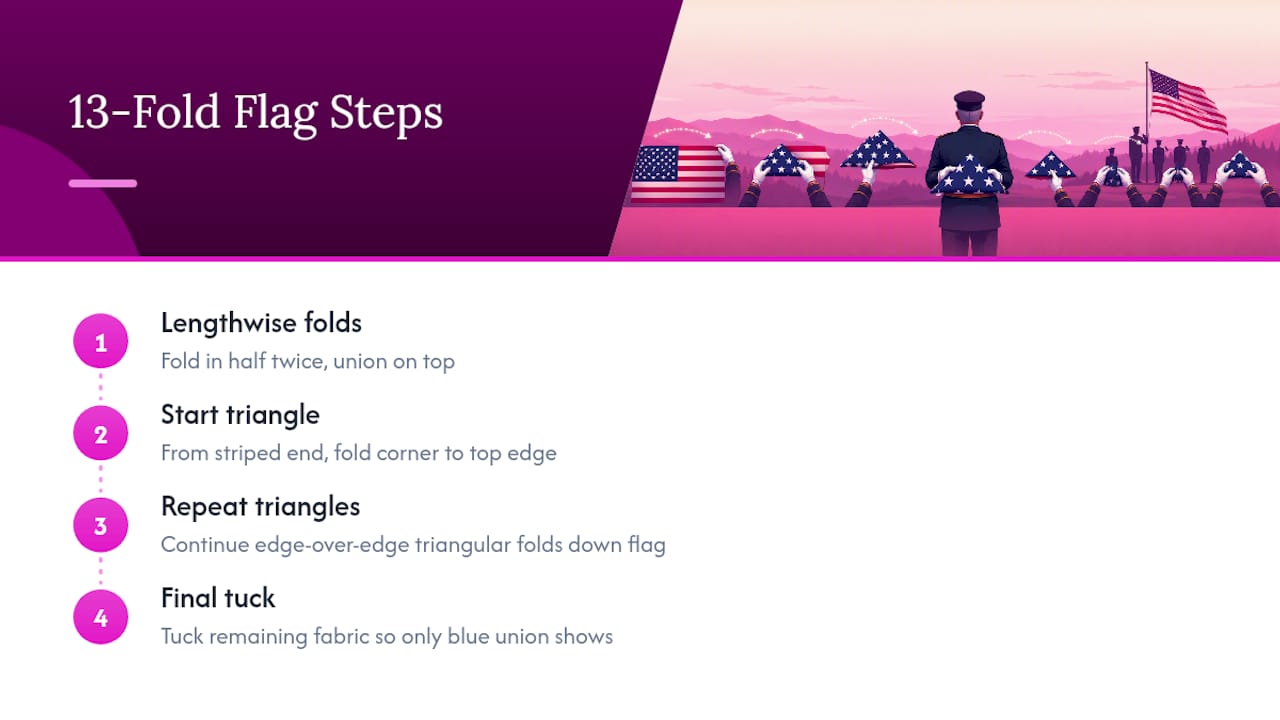
The final fold should tuck any remaining fabric into the pocket of the triangle so no red or white stripe shows on the outside; only the blue field with stars remains visible. This isn’t just aesthetic. The folded triangle is meant to evoke the tricorn hats worn by soldiers during the American Revolution, and it’s the form used when a flag is presented to the family of a fallen service member.
Flag Protocols During Mourning and National Emergencies
When the nation observes a period of mourning, the flag’s position shifts to reflect it, and the authority to order that shift follows the same chain covered earlier in this guide. A presidential proclamation typically triggers a nationwide half-staff period following the death of a President, other high federal officials, or in response to a mass casualty event.
During these periods, the sequence for raising and lowering the flag stays the same. Raise it to the peak first, then lower it to half staff, and reverse that at day’s end. What changes is the duration and scope, which the proclamation itself defines. Some orders apply only to federal buildings; others extend to state and local government flags as well, depending on how the governor’s office chooses to align with the federal order.
Checking the current status matters more during these periods than any other time. The American Legion and most state government websites post active half-staff notices, and following them precisely, rather than relying on what a neighbor’s flagpole is doing, is the surest way to stay in line with the actual order.
Why This Guide Exists: A Veteran-Focused Perspective
The people who care most about getting flag etiquette right are rarely the ones who need convincing. Veterans notice a backward union on a lapel pin. Gold Star families notice when a folded flag isn’t quite crisp. The Flag Code reads like a legal document, but its real audience has always been anyone who wants to get the small details right because those details carry weight for someone else in the room.
Most etiquette mistakes come from good intentions paired with bad information, not disrespect. Someone drapes a flag over a casket the wrong way because nobody taught them the union goes over the left shoulder. Someone buys a flag t-shirt for a barbecue without realizing it crosses a line the Flag Code drew decades ago. Use the sections above as a working checklist, not a test to pass once and forget.
— Ian
Show Your Patriotism the Right Way
Full-flag prints on disposable apparel put you on the wrong side of the etiquette this guide just covered. Some apparel catalogs focus on veteran-themed designs, tributes, and motifs that honor the flag without wearing it. Every piece channels the same respect the Flag Code asks for, minus the guesswork about what’s actually appropriate to wear.

Browse pieces like the VietNam Classic tee, the Stars and Stripes Unisex Hoodie, or the Fortune Favors Unisex classic tee if you want something built to represent the flag’s meaning rather than its literal image. Some veteran-themed apparel brands donate a portion of sales to veteran support programs, so the pieces you wear do more than sit in a closet between Fourth of July weekends. Head to the Warbeardproject catalog and pick the design that fits how you want to show respect.
Where to Check the Official Rules Yourself
- 4 U.S.C. § 6 — the statute governing display times and illumination.
- 4 U.S.C. § 7 — position, manner, and precedence rules.
- 4 U.S.C. § 8 — respect provisions and prohibited uses.
- VA flag display guidance — ceremony and half-staff practices in plain language.
- Usa — a public-facing summary for everyday questions.
Sources
- 4 U.S.C. § 6 - Time and occasions for display
- 4 U.S.C. § 8 - Respect for flag (summary)
- Flag display guidance - U.S. Department of Veterans Affairs
- Usa