

Screen Print vs DTG: What to Pick for Any Order Size
Pick DTG for one-off shirts, photo-quality art, and orders under roughly 24 pieces. Pick screen printing for bulk runs, dark garments that need solid opacity, and any design that calls for specialty ink. That’s the whole decision in one sentence. However, three variables can move it: run size, fabric composition, and finish requirements.
The crossover point between the two methods sits around 24 pieces. This is the spot where screen printing’s per-color setup fees finally get outrun by DTG’s flat per-unit ink cost. Below that number, DTG usually wins on price and turnaround. Above it, screen printing pulls ahead, especially once a design uses two or three solid colors instead of a full-color photograph.
Two things shift that number in either direction. A design with five or more colors pushes the crossover higher because each color needs its own screen. A run of dark hoodies needs a heavy white underbase either way, which adds cost to both methods but hits DTG turnaround harder.
- DTG works best for: single shirts, personalized gifts, small donor-tee batches, and any design with gradients or photo-realistic detail.
- Screen printing works best for: 25+ identical shirts, bold logo work, dark garments, and specialty finishes like puff or metallic ink.
- Crossover reference point: around 24 pieces, adjustable based on color count and fabric.
Quick number to remember: 24 units is the general break-even point where screen printing typically starts beating DTG on cost per shirt. Below it, DTG’s zero setup fee usually wins outright.
Key Takeaways
The right printing method depends almost entirely on run size, fabric, and whether your design needs a specialty finish that only screen printing can deliver.
| Point | Details |
|---|---|
| Match method to run size | Choose DTG under roughly 24 shirts and screen printing above that crossover point. |
| Fabric drives fit | Pick DTG for light cotton photo prints and screen printing for dark garments or blends. |
| Specialty finishes decide it | If you need metallic, puff, foil, or discharge ink, screen printing wins regardless of quantity. |
| Get apples-to-apples quotes | Request itemized quotes and a physical sample swatch before committing to a full run. |
| Consider running both | Many operations use DTG for personalized pieces and screen printing for bulk to cut waste and cost. |
Table of Contents
- Screen Print vs DTG Printing: How Each Method Actually Works
- Screen Printing vs DTG: Comparing Every Decision Factor
- How Much Does Each Method Cost Per Shirt?
- Which Fabrics and Colors Work Best With Each Method?
- How Long Do Screen Prints and DTG Prints Actually Last?
- What Specialty Effects Only Screen Printing Can Do?
- What Do the Machines Actually Cost to Run?
- Is DTG or Screen Printing Better for the Environment?
- Decision Checklist: Questions to Ask Before You Order
- Why Smart Print Operations Use Both Methods
- Why Warbeard Project Chooses Different Methods for Different Product Lines
- Sources
Screen Print vs DTG Printing: How Each Method Actually Works
Before comparing costs and durability, it helps to know what each process physically does to a shirt. That mechanical difference explains almost everything else in this guide, from why dark garments behave differently to why one method scales cheaper than the other.
What Direct-to-Garment (DTG) Printing Is
DTG is inkjet technology that sprays water-based ink directly onto fabric, the same basic principle as a desktop printer but built for cotton instead of paper. There are no screens, no setup fees per color, and no minimum order. You can print one shirt with a hundred colors for the same base cost as printing one shirt with two colors.
Dark fabric changes that math. Because DTG ink is semi-transparent, a black or navy shirt needs a white ink layer sprayed first so the design colors show up true. That white underbase pass adds printing time, consumes more ink, and typically raises the per-unit price on dark garments compared to light ones.
DTG’s real strength shows up on light-colored, high-cotton shirts carrying photo-quality art: gradients, shading, small text, and full-color graphics that would require a dozen screens to reproduce any other way. There’s no setup cost standing between you and a single custom shirt.
The trade-offs are practical rather than dramatic. DTG performs best on 100% cotton or high-cotton blends. Per-unit ink cost stays flat no matter the order size, so it never gets cheaper at volume the way screen printing does. Printheads also need regular cleaning to prevent clogging, which is a shop-side maintenance concern more than a buyer concern, but it affects turnaround if a machine goes down mid-run.
- Sprays water-based ink directly onto fabric, no screens required.
- Needs a white underbase pass on dark garments, adding time and cost.
- Handles unlimited colors and photo-realistic detail at no extra setup charge.
- Works best on cotton and high-cotton blends; struggles on high-polyester fabric.
- Printheads require routine maintenance to avoid clogging mid-run.
Pro Tip: Send your printer a high-resolution file (300 DPI minimum) in a CMYK or RGB profile with a transparent background. Low-res logos pulled from a website almost always print blurry on DTG, since the printer reproduces exactly what it receives.
What Screen Printing Is
Screen printing pushes ink through a mesh screen using a squeegee, with one screen cut for every color in the design. A two-color logo needs two screens; a five-color design needs five. That per-color setup is the method’s biggest cost driver and the reason small orders get expensive fast.
Most shops use plastisol ink, which sits on top of the fabric rather than absorbing into it and cures at roughly 320°F. That curing step is what makes screen-printed graphics feel slightly raised and why they hold their color so well over repeated washes. Water-based inks are also common, especially for a softer hand-feel or a more eco-conscious ink line.
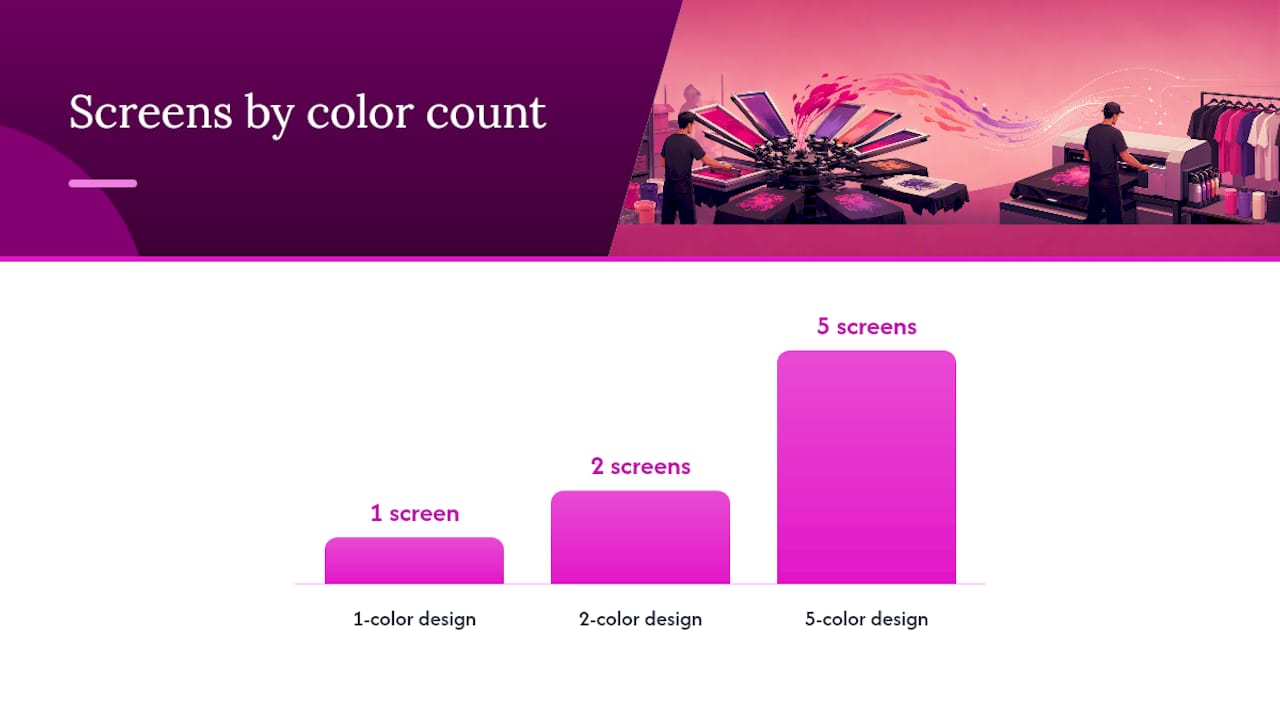
Screen printing’s advantages show up clearest at volume and on dark fabric. Because the ink layer sits opaque on top of the shirt, a screen-printed white logo on a black hoodie looks solid and bright without the extra white-ink pass DTG requires. Setup costs get divided across the whole run, so the per-shirt price drops as quantity climbs. Screen printing also unlocks specialty finishes, like discharge, metallic, foil, and puff ink, that DTG simply can’t reproduce.
The constraints run in the opposite direction from DTG’s. Setup takes longer, since each screen has to be burned and registered before the first shirt runs. Screens need physical storage space, and shops typically charge a setup fee per color regardless of order size. Fine photographic gradients are also harder to achieve without halftone or simulated-process techniques, since standard screen printing works best with solid, distinct colors rather than smooth blends.
- Uses one mesh screen per color, pressed through with a squeegee.
- Plastisol ink cures around 320°F and sits raised on the fabric surface.
- Delivers strong opacity on dark garments and lower cost per unit at scale.
- Supports specialty finishes: metallic, foil, puff, discharge, and glitter inks.
- Requires per-color setup fees and screen storage space.
Pro Tip: Mesh counts between 305 and 355 can reproduce fine halftone detail surprisingly well. The real ceiling on screen printing isn’t resolution, it’s color count. More colors means more screens, more setup time, and a higher minimum order to make sense financially.
Screen Printing vs DTG: Comparing Every Decision Factor
| Factor | DTG | Screen Printing |
|---|---|---|
| Run size / per-unit cost | Flat cost per shirt regardless of quantity | Cost per shirt drops as quantity rises |
| Upfront setup cost | None, or minimal | Per-color screen fees apply |
| Print complexity | Unlimited colors, photo detail | Best with solid colors, limited by screen count |
| Color vibrancy on darks | Needs white underbase, softer opacity | Strong opacity, especially with plastisol |
| Durability / washfastness | Improved but still fabric-dependent | Generally stronger long-term washfastness |
| Fabric compatibility | Best on cotton, weak on high-poly | Handles cotton, blends, and performance fabric |
| Turnaround time | Fast for single or small orders | Slower start due to screen setup |
| Specialty inks & finishes | Very limited | Metallic, foil, puff, discharge, glow-in-the-dark |
| Equipment cost & maintenance | High machine cost, daily printhead care | Lower entry cost, screen storage and reclaiming |
| Environmental impact | Water-based ink, supports print-on-demand | More water and chemical use for screen cleaning |
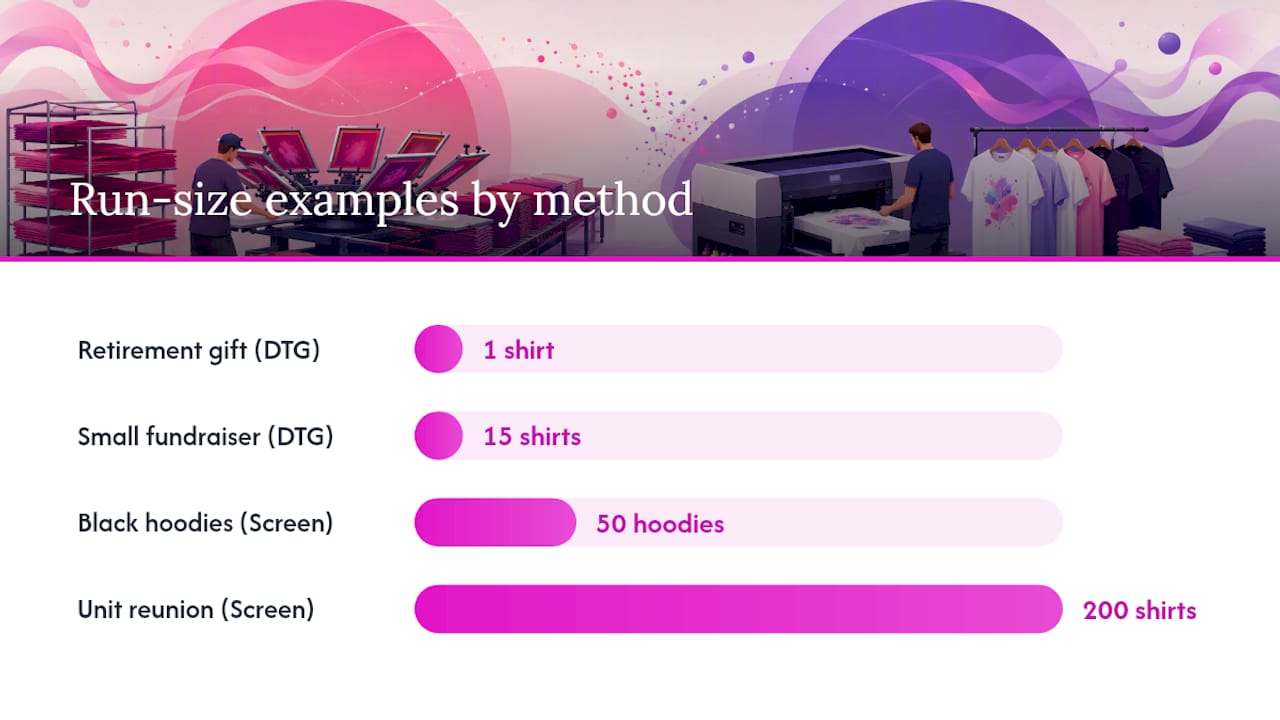
The single factor that decides most of this table is run size. Everything else, color vibrancy, cost per shirt, even environmental footprint, bends around how many shirts you’re actually ordering. Screen printing dominates bulk orders with bold, opaque color, while DTG dominates short runs and photorealistic artwork, and treating that as a spectrum rather than a rulebook keeps you from overpaying either way.
A few quick scenarios make the pattern concrete:
- One custom photo shirt for a retirement gift: DTG, no question, since there’s no minimum and no setup fee.
- 200 shirts for a unit reunion with a two-color logo: Screen printing, since the setup cost spreads across 200 units instead of one.
- 15 shirts with a five-color gradient design for a small fundraiser: DTG, since five screens for 15 shirts rarely pencils out.
- 50 black hoodies needing a bright white chest logo: Screen printing, for opacity and washfastness on dark fabric.
Before requesting quotes, prepare print-ready art files, know your exact garment color and fabric blend, and settle on a firm quantity. Ask for a physical sample proof on the same shirt style you’re ordering, not a generic mockup, so you can judge color accuracy and hand-feel before committing to a full run.
How Much Does Each Method Cost Per Shirt?
DTG’s cost structure is simple: a flat per-unit ink charge plus a pretreatment charge on dark garments, multiplied by quantity. There’s no setup fee working against you, but there’s also no volume discount built into the ink cost itself.
Screen printing works differently. You pay a setup fee per color up front, and that fee gets amortized across the entire run. Order 12 shirts with a three-color design and you’re covering three screens across just 12 units. Order 300 shirts with the same design and those same three screens cost a fraction of a cent more per shirt.
These are example ranges only. Actual pricing shifts with shirt brand, print size, ink colors, and your specific vendor, so treat this table as a planning tool rather than a quote.
A few variables move the crossover point beyond raw quantity. A large print area (full front and back, for example) increases both material and labor cost on either method. More colors raise screen printing’s setup cost specifically. Specialty inks add a flat surcharge regardless of run size. And dark garments requiring a heavy white underbase raise DTG’s per-unit cost more than it raises screen printing’s, since screen printing’s opacity comes from the ink chemistry rather than an extra pass.
Pro Tip: Ask every printer to break down the quote line by line: setup fee per screen, number of screens required, white-underbase passes on dark shirts, and any per-shirt ink allowance caps. A vague single “$14 per shirt, all-in” quote hides which cost driver is actually eating your budget.
Which Fabrics and Colors Work Best With Each Method?
DTG performs best on 100% cotton or high-cotton ringspun blends, since the water-based ink needs natural fiber to properly absorb into. Push past roughly 50% polyester and DTG ink starts sitting on the surface instead of bonding, which shows up as dull color or premature cracking after a handful of washes unless the shop uses specialized pretreatment chemistry built for blends.
Screen printing handles a wider range of fabric without much fuss, cotton, cotton-poly blends, and even some performance fabrics, because plastisol ink forms its own bonded layer on top of the fibers rather than depending on fabric absorption. That’s also why screen printing manages dark garments more reliably: opacity comes from the ink itself, not from how well the fabric accepts a white base coat.
- Choose DTG for light-colored, 100% cotton shirts carrying photo-quality or full-color art.
- Choose screen printing for dark garments, poly-blend fabric, and performance wear.
- If you need photo-quality art on a poly blend or dark garment, ask about DTF (direct-to-film) transfers as a middle-ground alternative.
- Avoid standard DTG on moisture-wicking athletic shirts; the coatings that repel sweat also repel ink adhesion.
Watch for coated or treated performance fabrics specifically. Anything marketed as moisture-wicking or quick-dry usually has a surface finish designed to resist absorption, which works against both DTG ink and, to a lesser degree, plastisol bonding. Always request a test print on the exact fabric you’re ordering rather than assuming a standard cotton result will transfer.
How Long Do Screen Prints and DTG Prints Actually Last?
Properly cured plastisol screen prints generally outlast DTG prints across normal wash cycles, largely because the cured ink forms a durable bonded layer rather than depending on fiber absorption. Modern DTG systems have narrowed that durability gap considerably, but the result still depends heavily on fabric composition, pretreatment quality, and whether the shop properly cured the ink before shipping.
The care instructions that extend print life are nearly identical for both methods: wash inside-out in cold water, skip the dryer’s high heat setting or air-dry when possible, and avoid bleach and fabric softener, both of which break down ink bonds over time.
- Wash inside-out to reduce direct friction on the printed surface.
- Use cold water and a gentle cycle whenever the design has fine detail.
- Air-dry or use low heat; high dryer heat is the single fastest way to crack a print.
- Skip bleach and fabric softener on printed garments entirely.
The fabric-blend caveat matters most for anyone ordering DTG on athletic or performance shirts. Higher-polyester blends cause DTG prints to fade noticeably faster than cotton unless the shop uses specialized ink chemistry built for synthetic fiber, something worth confirming before you commit to a bulk order for a durable, mission-driven apparel collection.
Pro Tip: If durability matters for your order, request a sample swatch and wash it five to ten times before approving the full run. Check for cracking, fading, and whether the print still feels flexible rather than stiff or peeling at the edges.
What Specialty Effects Only Screen Printing Can Do?
Metallic, foil, puff, discharge, glitter, glow-in-the-dark, and reflective inks are reliably produced with screen printing and generally unavailable through standard DTG workflows. If your design calls for any of these finishes, that requirement alone should settle the method question, regardless of run size.
These effects depend on screen-based chemistry that layers or reacts with the fabric in ways a DTG printhead simply isn’t built to replicate. Puff ink expands during curing to create a raised texture. Discharge ink chemically removes the shirt’s dye before depositing new color, producing a soft, vintage look impossible to fake with surface-level inkjet spray. Foil requires an adhesive layer applied through a screen before the foil sheet is pressed on. None of that translates to an inkjet process.
- Discharge: removes fabric dye first, leaving a soft, worn-in finish.
- Puff: ink expands under heat for a raised, textured surface.
- Metallic and foil: reflective finishes requiring adhesive layering through a screen.
- Glow-in-the-dark and glitter: specialty pigments mixed into screen ink formulas.
If a design absolutely requires one of these finishes, choose screen printing even for a small run and bench-test a sample before committing to full production. The exception worth knowing: heat transfers and DTF (direct-to-film) prints can approximate some metallic or glitter effects at small scale, though usually with a stiffer hand-feel and shorter wash life than a true screen-printed finish.
What Do the Machines Actually Cost to Run?
Entry-level DTG units typically start around $15,000, while production-grade machines can exceed $100,000, before factoring in pretreatment stations, curing ovens, and RIP software licenses. Screen printing’s entry point is lower on the manual side, basic tabletop presses cost far less, but automatic presses and industrial dryers close much of that gap at production scale.
Maintenance obligations differ sharply between the two. DTG printheads need daily cleaning to prevent clogging, since dried ink in the nozzles is one of the fastest ways to ruin a run and cause costly downtime. Screen printing’s maintenance burden shows up differently: screens need reclaiming and storage space, ink inventory has to be managed across multiple colors, and curing equipment needs regular temperature calibration to guarantee proper cure at that ~320°F threshold.
A useful reference point: the roughly $15,000 to $100,000+ range for DTG hardware alone explains why many shops specialize in one method and outsource the other rather than owning both sets of equipment outright.
- Ask which specific machine models a shop runs, not just “DTG” or “screen printing” as a category.
- Ask how often printheads are cleaned and whether they’ve had recent downtime issues.
- Ask how screens are stored and reclaimed between jobs, since poor storage degrades detail over time.
- Ask about backup equipment in case a machine goes down mid-order.
Is DTG or Screen Printing Better for the Environment?
Traditional screen printing uses more water and chemical handling for screen cleaning and reclaiming, while DTG’s water-based inks and no-minimum-order structure support print-on-demand fulfillment that reduces overproduction and unsold inventory.
That operational difference matters beyond the ink itself. Screen printing shops manage solvent waste, ink disposal, and energy use for curing ovens. DTG shops manage energy for pretreatment stations and printhead cleaning solutions, generally a lighter chemical footprint but not a zero one.
- DTG minimizes inventory risk since shirts can be printed one at a time as orders come in.
- Screen printing, run at efficient volume, produces less waste per unit despite higher water use overall.
- Ask any vendor how they handle wastewater from screen reclaiming and what ink lines they use.
- Look for water-based or eco-solvent ink options if environmental impact weighs into your decision.
If minimizing unsold inventory matters more to your operation than unit cost, DTG’s print-on-demand model reduces overproduction risk in a way that bulk screen printing simply can’t match, since every screen-printed order commits you to a fixed quantity up front.
Decision Checklist: Questions to Ask Before You Order
Work through these questions before requesting a single quote, and you’ll walk into every printer conversation with the leverage of someone who already knows the right questions to ask.
- What’s my expected run size, and does it fall above or below the 24-piece crossover range?
- What fabric and garment color am I printing on, cotton, blend, or performance fabric, light or dark?
- How many colors does my design use, and does it include gradients or photo-quality detail?
- Do I need any specialty finish, metallic, puff, discharge, or foil?
- What’s my turnaround requirement, and does that rule out one method entirely?
- What’s my target budget per unit, and how does that shift with my expected reorder frequency?
When you reach out to printers directly, ask these questions and expect clear, specific answers:
- What’s your crossover estimate for a job exactly like mine?
- Can you provide a physical sample swatch on the actual fabric and color I’m ordering?
- How is your setup fee calculated, per color, per screen, or a flat design fee?
- What’s your cure test procedure, and can you show wash-test results?
- Can you match a specific Pantone color, and how close is your typical match?
- Do you support specialty inks, and which ones specifically?
Watch for these red flags in any quote you receive. A vague setup fee description with no per-color breakdown usually hides inflated costs. No sample photos on your actual garment and fabric, only generic mockups, is a sign the shop hasn’t tested your specific job. Unwillingness to explain their white-underbase protocol for dark garments suggests they may skip a proper opacity pass. And unclear or missing wash-testing results mean you’re gambling on durability without evidence.
Pro Tip: Send the exact same design, fabric spec, and quantity to at least three printers, one DTG shop, one screen printer, and one hybrid shop. Request itemized quotes rather than flat per-shirt numbers, so you’re comparing apples to apples instead of guessing which line items differ.
Why Smart Print Operations Use Both Methods
Production experts increasingly frame this less as “which method wins” and more as a toolbox decision. DTG works best for flexible, low-volume, high-margin small runs, while screen printing handles consistent, cost-sensitive bulk orders, and the shops getting the best margins use both depending on the job in front of them.
A common strategy: run color-limited bulk items, staff shirts, event tees, standard merch drops, on screen printing, where setup cost gets amortized across volume. Route photo-quality or fully custom individual orders to DTG, either in-house or through an outsourced DTG partner, where there’s no minimum order and no setup penalty for a one-off design.
Consider a small nonprofit merch program raising funds for veteran outreach. Event staff need 150 identical bulk shirts with a two-color logo, a clear screen-printing job given the volume and simple color count. Meanwhile, individual donors receive personalized tees with their name and a photo-quality graphic, a job that only makes financial sense on DTG since each shirt is technically a unique small run of one.
- Use DTG for design samples before investing in screens for a design you’re not fully committed to yet.
- Keep inventory light on DTG-printed items since they can be produced on demand.
- Price screen-printed bulk items lower per unit to reflect the setup cost you’ve already amortized.
- Coordinate lead times carefully: DTG turns around fast, screen printing needs setup time built into your schedule.
Why Warbeard Project Chooses Different Methods for Different Product Lines
The method question isn’t abstract for us. Bulk event and fundraiser tees, the kind ordered in the dozens for a unit reunion or a veteran support drive, go through screen printing because the durability and cost-per-unit make sense at that volume, and because those shirts tend to get worn and washed hard for years.
Limited personalized fundraising gifts and photo-based pieces run through DTG instead, since there’s no setup fee working against a run of five or ten shirts, and the flexibility matters more than shaving a few dollars off unit cost. That balance comes down to two constraints we weigh on every product decision: donation margins have to hold up regardless of print method, and any item expected to see frequent washing needs to survive that wear without the graphic cracking or fading within a season.
We’ve written more on how that plays out for nonprofit apparel partnerships and for building a personalized deployment care package, two production scenarios where the method choice looks completely different despite starting from the same design file. If you’re weighing a mission-driven print run of your own, our yoga leggings line shows how the same decision framework applies beyond t-shirts, matching fabric, finish, and order volume to the right production method rather than defaulting to whichever method a shop happens to prefer.
Sources
These sources go deeper on the mechanics, economics, and specialty finishes covered above, and they’re worth a direct read if you want the technical detail behind a specific claim.
- Screen Printing vs DTG Printing: How to Choose the Right Method — Printable Press
- Direct-to-garment printing — Wikipedia
- DTG vs Screen Printing — Shopify blog
Treat these as starting points rather than the final word. Every print shop runs slightly different equipment, ink lines, and pricing structures, so verify specifics, especially cure procedures and wash-test results, directly with whatever printer you’re considering for your own order.