

14 Preservation First Challenge Coin Display Ideas for Collectors
The best challenge coin display ideas fall into four categories: tiered desk racks for growing collections, shadow boxes for archives and memorabilia, floating frames for a single feature coin, and acrylic stands for a clean modern look. Choose based on collection size and value, but never skip protection from UV light and humidity, and always leave room to grow.
TL;DR:
- Use modular, expandable display options like tiered racks, hinged cases, or shadow boxes to accommodate growing collections and prevent obsolescence.
- Protect coins from light, humidity, and chemical off-gassing by choosing acrylic or glass cases, using silica gel packets, and avoiding PVC or raw cardboard.
- Organize collections by chronology, location, or theme, and label them with concise metadata to enhance storytelling and accessibility.
- Build simple tiered racks with proper groove angles and depths, ensuring fit and stability by dry-fitting actual coins before final assembly.
- Secure valuable collections with lockable cases or furniture placed away from windows, and consider insurance for high-value items.
Table of Contents
- Challenge Coin Display Ideas Worth Building or Buying
- How to Build a Simple Tiered Coin Rack in an Afternoon
- Materials and Preservation: Protecting Coin Finishes Long-Term
- Organizing Your Collection So It Tells a Story
- What Warbeard Project Sees Collectors Get Wrong
- Locking Down a Display: Security Basics Collectors Skip
- A Builder’s Take on Displays That Actually Last
- Gear That Honors What Your Coins Represent
- Resources for Building and Protecting Your Display
- Sources
Challenge Coin Display Ideas Worth Building or Buying
Every collector eventually hits the same wall: a shoebox full of coins that deserve better. Below are the display formats that actually solve the problem, ranked by how often serious collectors reach for them.
-
Tiered wooden desk racks. The classic choice. Measure your coins first, since diameters range from 1.5 inches to over 2 inches, and slot width has to match or coins rattle loose.
-
Shadow boxes and wall-mounted cases. Enclosed glass-front cases work best for large collections and archival preservation, especially when you mix in patches or photos for context.
-
Floating frames for feature coins. A single standout coin, maybe your first command coin or a deployment memento, deserves its own spotlight using silicone suspension that holds it mid-air between two panes.
-
Acrylic stands and frames. Minimal, modern, and inexpensive. Good for desks and shelves where you want the coin visible from both sides without a bulky wooden frame.
-
Multi-tier pyramids. These stack rows at increasing height, so a whole unit’s worth of coins reads as one visual block instead of a scattered pile.
-
Rotating display stands. Useful for collections you want to show off from every angle, particularly two-sided coins with high-relief artwork on the back.
-
Magnetic panels. Convenient, but proceed carefully. Attaching magnets directly to a coin’s back can reduce its collectible value, so use recessed, non-adhesive discs inside a capsule instead of gluing a magnet to the metal itself.
-
Embedded glass-top furniture. A coffee table or shadow-box desk insert turns a collection into a conversation piece every time someone sets down a coffee cup.
-
Coin capsules. Individual protection for high-value pieces, ideal for coins you rotate in and out of a feature display.
-
Velvet-lined presentation boxes. These photograph well and travel safely, making them the right pick for coins you take to reunions or hand down.
-
Laser-cut acrylic inserts. Modern woodworkers increasingly favor laser-cut or CO2-cut acrylic over drilled holes because it leaves clean, non-destructive apertures that show off both faces of a coin.
-
Modular hinged-front cases. Instead of buying a fixed 50-slot rack and outgrowing it in a year, a hinged front with tiered rows lets you add sections as your collection expands.
-
Themed shadow boxes. Background scenes, unit patches, or a folded flag corner turn a simple case into a display that tells a story at a glance.
-
Uniformed motif frames. Pairing a coin with a small patch or rank insignia inside the same frame gives visual context without cluttering the piece itself.
The common thread across all fourteen: whatever you build or buy, treat expandability and protection as requirements, not upgrades. A modular design with hinged glass fronts prevents the display from becoming obsolete the moment your collection outgrows it.
How to Build a Simple Tiered Coin Rack in an Afternoon
You do not need a full workshop to build a solid rack. A circular saw or table saw, a miter gauge, sandpaper, and an afternoon are enough.
Tools and materials checklist:
- A board roughly 11 to 12 inches long (pine, oak, or walnut all work)
- Table saw or miter saw with a stable fence
- Sandpaper in 120, 220, and 400 grit
- Boiled linseed oil or tung oil
- Wood glue and clamps if building multiple tiers
Cut your grooves at an angle between 5 and 14 degrees so coins lean back slightly and stay put without adhesive. Measured builds commonly use this range, and some woodworkers, including the step-by-step plan from Osborne Builder’s Studio, cut closer to 14 degrees with slots spaced about 1 inch on center. Groove depth around 5/16 inch holds most standard coin thicknesses without swallowing the design.
Clean up kerf marks with a chisel, then sand progressively before oiling. Oil brings out the grain without leaving a film that traps humidity against the wood.
Pro Tip: Dry-fit two or three of your actual coins before you cut the full rack. Slot width that looks right on paper sometimes pinches a thicker commemorative coin.
Mount the finished rack with removable strips or a French cleat rather than screws through the display face, so you’re not drilling into a wall stud every time you rearrange.
Materials and Preservation: Protecting Coin Finishes Long-Term
What touches your coin matters more than most collectors realize. Use these materials and skip the rest:
- Use: acrylic, glass, acid-free backing boards, velvet lining
- Avoid: PVC (it off-gases chemicals that discolor metal over time) and raw cardboard, which holds moisture
- Control humidity: keep silica gel packets inside sealed cases, especially in basements or coastal climates
- Control light: indirect LED lighting between 3000K and 4000K minimizes heat and UV exposure compared with halogen bulbs or direct sunlight
- Handle carefully: gloves or capsules prevent finger oils from etching into finishes
A rack sitting near a south-facing window will fade patinas and dull enamel faster than most collectors expect, sometimes within a single season of full sun exposure. Keep display pieces separate from archive storage: what you show and what you protect long-term don’t always need the same environment.
Organizing Your Collection So It Tells a Story
A rack full of coins in random order looks like clutter. The same coins arranged with intent look like a career.
- Chronological order: earliest coin to most recent, showing progression over years of service
- By deployment or geography: groups coins from the same posting or region together
- By branch or unit: keeps affiliations visually distinct within a mixed collection
- By theme: command coins separate from unit coins separate from commemorative pieces
There’s no single correct system, only the one that makes your collection legible to someone else. Label with concise metadata (date, unit, event) using small engraved plates or printed captions tucked behind each coin. Reserve your top row or center slot for the rarest piece, and leave at least one empty row for what comes next.
What Warbeard Project Sees Collectors Get Wrong
The coins that matter most are rarely the ones under glass in a shop window. They’re the ones tied to a name, a unit, a date that means something. A display case is just the frame; the memory is the point.
The most common mistake: buying a fixed-capacity case that looks full the day it arrives. Choose modular over rigid, and drop your highest-value coins into capsules before they ever touch a magnet.
Locking Down a Display: Security Basics Collectors Skip
A coin collection built over 20 years of service can represent real financial and sentimental value, yet plenty of collectors leave it on an open shelf. Basic security doesn’t require a safe room, just a few deliberate choices.
Locking display cases are the simplest upgrade. A shadow box or acrylic case with a small key lock on the front panel keeps casual hands off without hiding the collection from view. For higher-value coins, a lockable glass-top furniture piece does double duty as both display and secure storage.
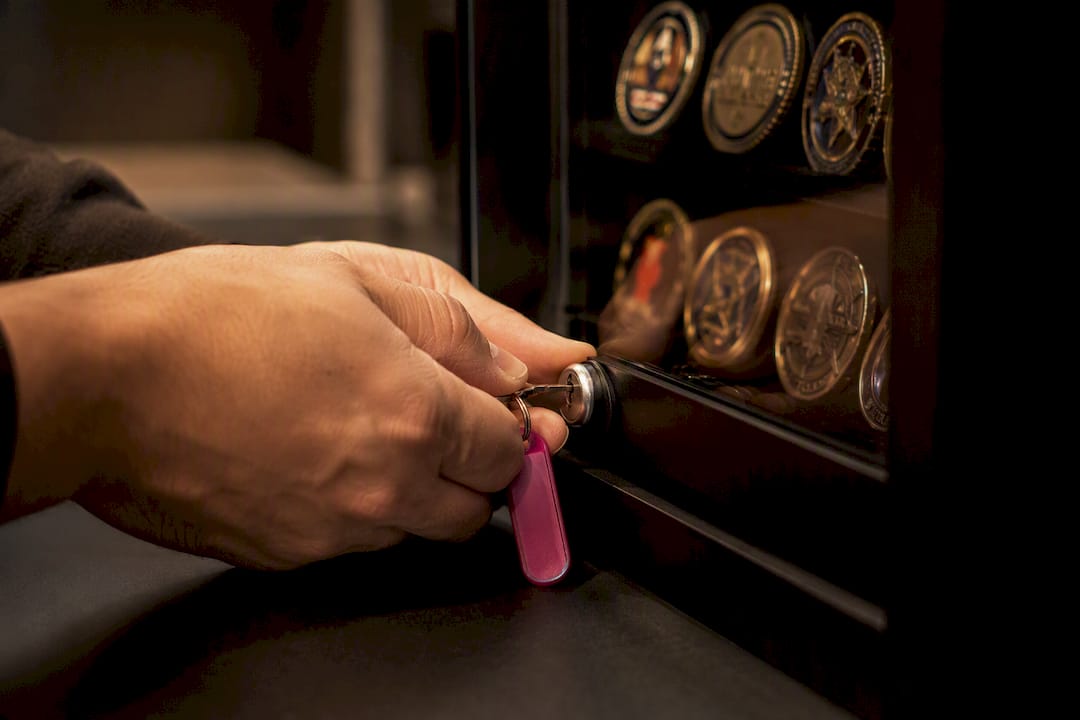
Placement matters as much as hardware. Keep display cases away from ground-floor windows visible from outside, and avoid photographing your full collection for social media with identifiable home details in the background. A rack visible through a front window is an invitation.
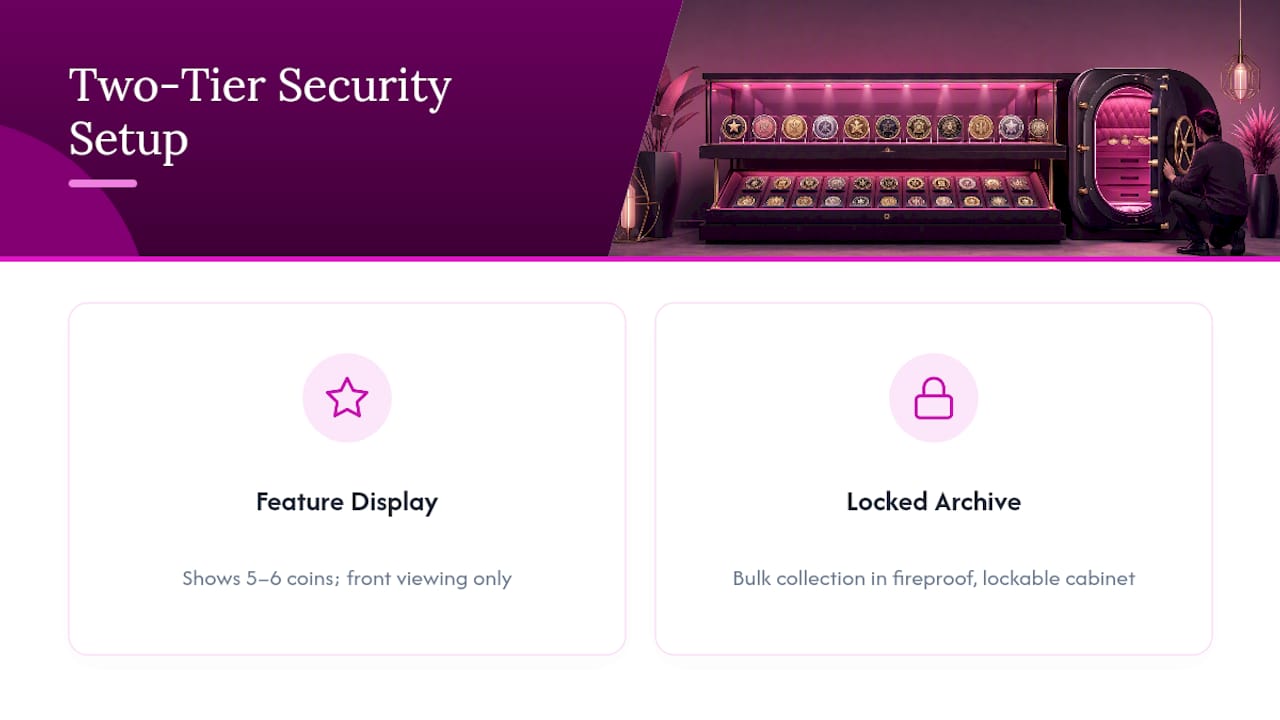
For collections with significant monetary value, a fireproof, lockable cabinet with a glass viewing panel offers the display quality of a case with the protection of a safe. Some collectors split the difference: a small rotating display holds five or six feature coins for daily viewing, while the bulk of the collection stays in a locked archive case in a closet or office.
Renters insurance and homeowners policies sometimes cover collectibles under standard limits, but high-value collections often need a separate rider. It’s worth a call to your insurance agent once a collection’s replacement value climbs into four figures.
A Builder’s Take on Displays That Actually Last
I’ve watched collectors build beautiful racks that were full within a year and useless within two. The habit that saves you: measure your coins before you buy or build a single slot, and always reserve one open spot for whatever comes next.
— Ian
Gear That Honors What Your Coins Represent
Pride in a collection extends beyond the case it sits in. A certain company builds veteran-themed apparel and accessories around the same idea that drives a good coin display: honoring service without letting it fade into the background.

If you’re outfitting a display shelf or picking up something for a fellow veteran, the catalog covers the range. The VietNam Classic tee and PTSD classic tee speak directly to service history, while the Fortune Favors Unisex classic tee and Special Edition VAWP2607 Unisex classic tee work as everyday wear or a gift alongside a new display case. For cooler months, the OG Logo Premium recycled bomber jacket adds a heavier statement piece, and the Lift Heavy Premium tank top covers training days. At home, the OG Logo Women’s pajama shorts and OG Logo Women’s pajama pants round out a set for family members who share the pride. Browse the full Warbeard Project catalog and find the piece that fits your next gift or your own closet.
Resources for Building and Protecting Your Display
- The Patriot Woodworker’s build guide: measured plans for a tiered wooden rack
- Osborne Builder’s Studio: a workshop-friendly alternate build with 14 degree cuts
- Midnight Woodworking’s acrylic insert guide: laser-cut apertures for a modern finish
- KidderCorp’s display etiquette overview: mounting warnings and organization systems
- Signature Laser Designs: custom engraving for nameplates and display accents
- Stars and Cents gift guide: ready-made display accessories for collectors
Sources
- Military Challenge Coin Display Build - The Patriot Woodworker
- How to Display Challenge Coins: Racks, Frames & Shadow Boxes | KidderCorp
- Challenge coin display | Midnight Woodworking