

280–340 gsm: Fleece or French Terry for Veterans' Hoodies and Merch
Fleece delivers more standalone warmth because its brushed nap traps air against the skin. French terry stays cooler and holds its shape better, making it the pick for active layering and structured everyday hoodies. GSM and fiber blend shift the outcome, and hoodies are built in constructions suited to both.
TL;DR:
- Fleece provides greater insulation and trapping of body heat due to its brushed nap, making it ideal for cold weather and standalone warmth.
- French terry offers better breathability and a sharper silhouette, suitable for activewear, transitional seasons, and fitted designs.
- Weight alone does not determine warmth; loft and construction significantly influence insulation, so compare fabric type alongside GSM ratings.
- Fleece is more prone to pilling due to its fuzzy fibers, whereas French terry resists abrasion better and holds its shape longer.
- For printing and branding, French terry’s flat surface produces crisper graphics, while fleece’s loft benefits puff and chenille effects.
Table of Contents
- Fleece vs French Terry: What’s Actually Different?
- Warmth, Breathability, and Durability Side by Side
- Reading GSM Numbers for the Right Season
- How Each Fabric Changes the Way a Hoodie Fits
- Washing and Storing Fleece and French Terry Correctly
- Which Fabric Prints and Embroiders Better?
- Choosing the Right Fabric for Your Hoodie
- Why Warbeardproject Weighs Fabric This Carefully
- Find Your Fit in the Warbeardproject Hoodie Lineup
- Sources
- FAQ
Fleece vs French Terry: What’s Actually Different?
The difference comes down to what happens to the yarn after it’s knit. French terry is a loop-back knit that leaves small uncut loops on the inside face, giving it a smooth outer surface and a slightly textured interior. Fleece starts from a similar knit base, but a mechanical brushing step tears those loops open into a fuzzy nap. That single finishing step is the whole story: one fabric keeps its loops intact, the other shreds them into fluff.
That brushing process is what makes fleece trap more body heat than an equivalent loop-back fabric. The raised fibers create thousands of tiny air pockets, and air is a poor conductor of heat, so warmth stays close to the body instead of escaping through the fabric.
Common fiber blends split along predictable lines:
- French terry: usually 100% cotton or cotton/poly blends (60/40 or 80/20), sometimes with a touch of spandex for stretch
- Fleece: cotton/poly blends dominate, though 100% polyester fleece shows up in performance and outdoor gear
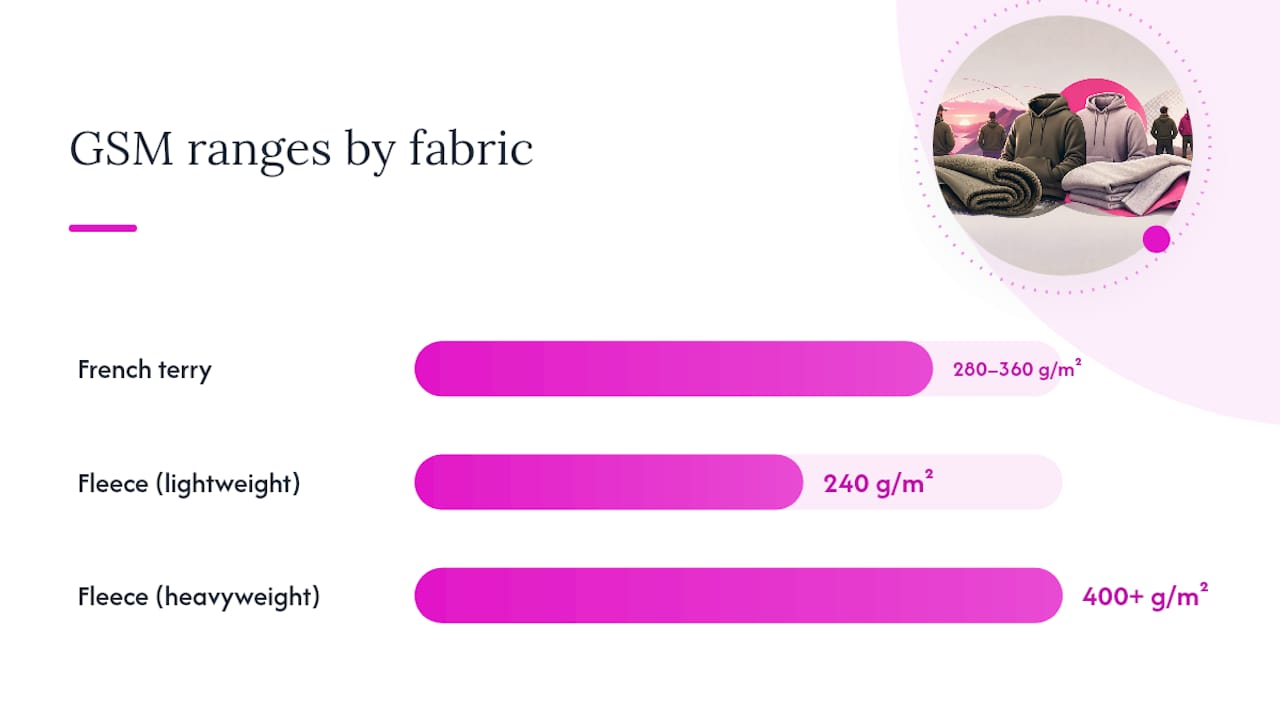
- GSM ranges: French terry generally sits around 280 to 360 grams per square meter for premium hoodies; fleece varies more widely, from lightweight 240 gsm options to heavyweight 400+ gsm pieces
Neither fabric is “better” in the abstract. They’re built to do different jobs.
Warmth, Breathability, and Durability Side by Side
The numbers only tell part of the story, but they’re a useful starting point before you factor in construction.
- Warmth: Fleece wins on raw insulation. The brushed nap creates loft, and loft is what holds warm air near the skin. French terry relies on loop cushioning instead, which insulates less but never turns clammy.
- Breathability: French terry’s open loop structure lets air move through the fabric, which is why it shows up in gym wear and transitional-season hoodies. Fleece’s dense nap restricts airflow, so it can feel stifling during activity.
- Weight and GSM: GSM alone doesn’t determine warmth. A 300 gsm fleece with heavy loft can feel warmer than a 340 gsm French terry, because loft adds perceived thickness without necessarily adding weight.
- Drape: French terry holds a cleaner, more structured line. Fleece drapes softer and looser, which changes how a hoodie hangs on the body.
- Durability and pilling: Brushed fleece is more prone to pilling because the raised fibers are exposed to friction. French terry’s tighter loop structure resists abrasion better, though both fabrics benefit from quality yarn.
Two hoodies at the same GSM can feel completely different on the rack. That’s construction, not marketing copy.
Reading GSM Numbers for the Right Season
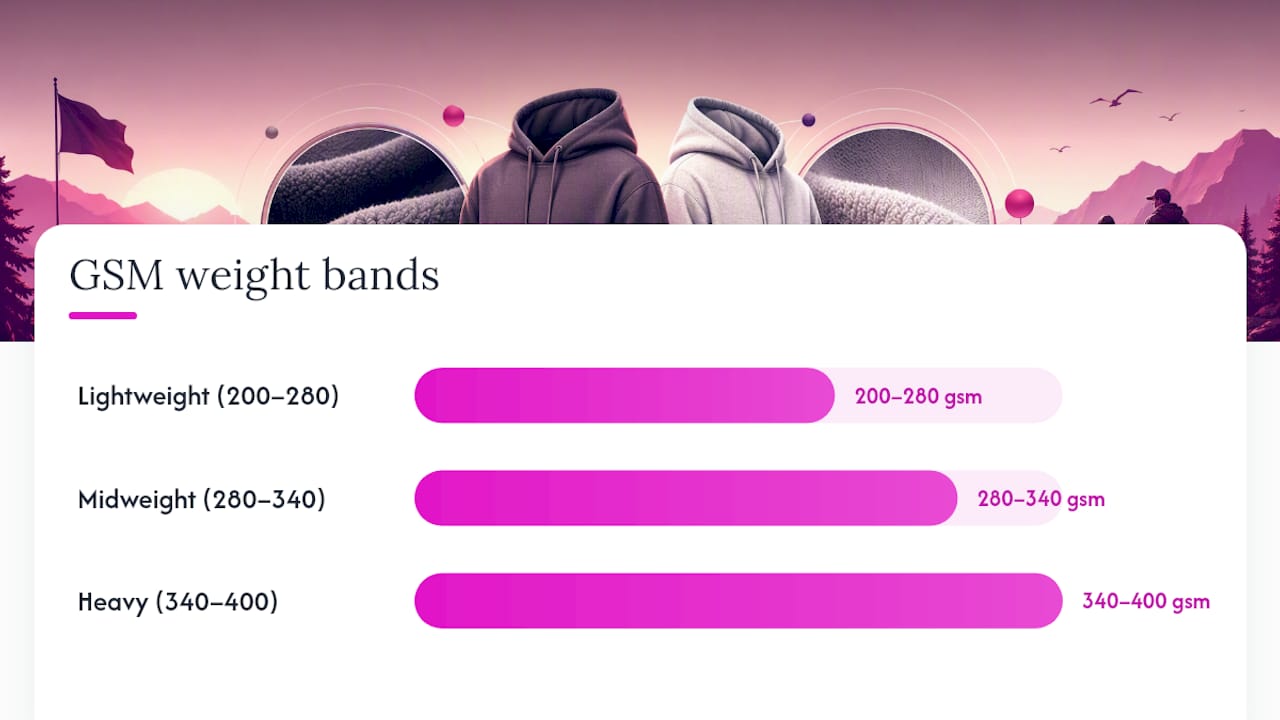
GSM tells you weight per square meter, but it only means something once you pair it with the fabric family. A 260 gsm French terry breathes completely differently than a 260 gsm fleece, because loft changes how the fabric behaves at rest and in motion.
Here’s how the bands typically translate into real-world feel:
- 200 to 280 gsm: Lightweight territory. French terry here works for spring layering and mild-climate everyday wear; fleece at this weight is closer to a light sweatshirt than a true cold-weather piece.
- 280 to 340 gsm: The midweight sweet spot. French terry hoodies at this range balance structure and breathability for year-round wear; fleece starts delivering real standalone warmth.
- 340 to 400 gsm: Heavyweight fleece territory, built for cold mornings and outdoor work. French terry rarely needs to go this heavy unless it’s a hybrid brushed-back construction.
- 400+ gsm: Reserved for serious winter fleece, often with a tighter brushed nap for maximum loft retention.
Loft matters more than the number on the label. A lofted mid-GSM fleece can outinsulate a denser, heavier cotton fabric gram for gram, which is why relying on GSM alone to judge warmth is a mistake worth avoiding.
How Each Fabric Changes the Way a Hoodie Fits
Fabric choice shapes silhouette as much as pattern cutting does. French terry produces a cleaner, more tailored drape, which is why it dominates fitted crewnecks and streetwear pieces that need to hold a defined line. Fleece falls looser and heavier, giving hoodies that slouchy, oversized look people reach for on a cold couch day.
- Want a fitted crewneck with printed graphics that reads sharp on camera? French terry.
- Want a plush, oversized hoodie for weekend loungewear? Brushed fleece.
- Layering under a jacket where bulk matters? French terry keeps the profile slim.
If you’re weighing silhouette against warmth, it helps to compare crewnecks against hoodies directly before locking in a fabric.
Washing and Storing Fleece and French Terry Correctly
Both fabrics lose their best qualities the same way: high heat and rough handling. Fleece loses loft when the nap gets crushed in a hot dryer, and French terry loops can stretch or shrink unevenly if washed carelessly.
- Wash cold, inside out, to protect the face fabric and any printed graphics.
- Dry on low heat or air dry, then reshape the garment while it’s still damp.
- Ask suppliers whether the fabric is pre-shrunk or sanforized. This stabilization step, combined with ring-spun yarns, keeps loft intact and shrinkage predictable wash after wash.
Expect some pilling on brushed fleece over time unless the piece uses an anti-pilling finish or long-staple yarns. Open-end yarn fleece compresses and pills faster than ring-spun construction, so the yarn quality behind the label matters as much as the weight.
Pro Tip: Skip the fabric softener on both fabrics. It coats the fibers and flattens the loft on fleece while gumming up the loops on French terry, which dulls the fabric’s hand over time.
Which Fabric Prints and Embroiders Better?
For crisp branded graphics, French terry’s flat face prints cleaner for screen printing and DTG, since there’s no nap to blur fine line work or small text.
- Fleece can still carry bold logos, but plastisol ink or DTF transfers usually hold up better than DTG on a napped surface.
- Puff prints and chenille patches actually benefit from fleece’s loft, since the texture hides stitch imperfections.
- Embroidery on either fabric needs proper backing. Denser stitch counts on fleece help prevent the nap from swallowing detail.
Choosing between screen print and DTG often comes down to which fabric you’ve already picked.
Choosing the Right Fabric for Your Hoodie
Match the fabric to what you’ll actually be doing in it, not what looks best on a hanger.
- Gym and active wear: French terry or a performance cotton/poly blend with wicking properties. You’ll stay dry through a workout instead of trapping sweat against your skin.
- Everyday hoodies: Midweight French terry around 280 to 340 gsm balances comfort, structure, and breathability for daily rotation.
- Cold-weather layers: Brushed fleece at 340 gsm or higher gives you standalone warmth without needing a jacket underneath.
- Branded merch with fine detail: French terry or a print-friendly face yarn holds crisp logos; save fleece for chenille or puff-print drops.
The lineup reflects that same logic. The OG Logo All-over Print Unisex Zip Hoodie suits layering days when you need a piece that goes on and off easily. The OG Logo Stars Unisex Hoodie works as a midweight everyday option. The OG Logo Unisex Hoodie covers the cozy, standalone-warmth use case. Match the fabric to the day ahead, not the other way around.
Why Warbeardproject Weighs Fabric This Carefully
Durability, the right GSM for the season, and printability for branded messaging all factor into how Warbeardproject builds its hoodie lineup. Mission-driven graphics need a face fabric that holds detail wash after wash, not one that blurs after a few cycles through the dryer.
Ian, who covers apparel construction for Warbeardproject, points out that most buyers overthink softness and underthink longevity. When picking from the catalog, match your climate and use case first, then let fabric weight and finish guide the final call.
— Ian
Find Your Fit in the Warbeardproject Hoodie Lineup
Hoodies are built around real use cases instead of chasing trend cycles, so you’re picking a fabric built for how you’ll actually wear it. If you need a piece that transitions between layering and standalone warmth, the OG Logo All-over Print Unisex Zip Hoodie covers that middle ground with an easy on-off zip front.

For everyday rotation, the OG Logo Stars Unisex Hoodie hits the midweight range that works from fall through mild winter. If cold mornings are the priority, the OG Logo Unisex Hoodie leans into standalone warmth. Wash cold and skip the high-heat dryer cycle to protect the fit and loft on either piece. Browse the full hoodie collection and pick the fabric that matches your season, not just your size.
Sources
- French terry vs fleece complete fabric comparison for hoodies and sweatshirts
- French Terry vs Fleece: Which Is Better for Premium Hoodies
FAQ
Which Is Warmer, Fleece or French Terry?
Fleece is warmer because its brushed nap traps more air against the skin, while French terry’s looped interior offers moderate warmth with better breathability.
Is French Terry Too Hot for Summer?
No. French terry’s open loop structure makes it one of the more breathable hoodie fabrics, which is why it’s a common choice for warm-weather layering and activewear.
What Is Fleece French Terry?
The term usually describes a hybrid fabric with a French terry loop back that’s been lightly brushed, blending some of fleece’s softness with French terry’s breathability and structure.
Is French Terry a Good Fabric?
Yes. French terry holds its shape well, resists pilling better than brushed fleece, and prints cleanly, which makes it a reliable choice for everyday hoodies and branded merch alike.