

How to Wear Branch Insignia Apparel Daily: 2026 Army Guide
Army branch insignia is authorized exclusively for official Army uniform wear under AR 670-1. Officers wear the insignia of their basic or detailed branch. Enlisted personnel wear the insignia of their Primary Military Occupational Specialty (PMOS). Basic trainees are prohibited from wearing branch insignia entirely. General officers may optionally wear branch insignia tied to their appointed position or duty assignment.
Key authorization rules at a glance:
- Officers: Wear basic branch insignia; when detailed to another branch, wear that branch’s insignia instead.
- Enlisted personnel: Wear branch insignia of their PMOS on the left collar of the Army Service Uniform (ASU).
- Basic trainees: Wear U.S. insignia on both collars only. Branch insignia is not authorized until graduation.
- General officers: May wear branch insignia at their option, tied to their appointed position.
- Placement on ASU: Officers center insignia on both lapels, approximately 1¼ inches below the U.S. insignia. Male enlisted personnel center it on the left collar, 1 inch above the notch. Female enlisted personnel place it 5/8 inch up from the collar seam.
- Placement on ACU: Branch insignia placement on the Army Combat Uniform follows separate specifications under AR 670-1, with recent updates from Army Directive 2026-16 affecting chaplain wear specifically.
What AR 670-1 actually requires for branch insignia wear
Army Regulation 670-1 is the controlling document for all branch insignia wear. It defines who wears what, on which uniform, and under what conditions. No other directive supersedes it for daily uniform wear unless explicitly noted.
The regulation distinguishes three categories of insignia authorization: basic branch, detailed branch, and PMOS. A soldier’s basic branch is the branch in which they were commissioned or enlisted. A detailed branch is one to which a commissioned or warrant officer has been formally assigned for duty. PMOS applies to enlisted personnel and determines which branch insignia they wear on the ASU.
Warrant officers follow the same framework as commissioned officers. They wear their basic branch insignia unless detailed elsewhere. The Inspector General branch insignia, for example, is worn only by the inspector general and officers formally detailed as inspectors general, not by anyone who performs related duties informally.
Authorized materials for branch insignia include metal devices and embroidered patches, both of which must conform to size specifications in DA PAM 670-1. Metal insignia must be maintained in a bright, clean condition. Embroidered versions must match the subdued color standards required for the ACU. Soldiers are responsible for replacing damaged or faded insignia promptly.
Pro Tip: Check DA PAM 670-1 alongside AR 670-1. The regulation sets the rules; the pamphlet provides the diagrams and precise measurements. Using both together eliminates most placement errors before they become uniform violations.
Officers detailed to the National Guard Bureau wear National Guard Bureau branch insignia when the detail runs 180 days or longer, as prescribed by the Chief, National Guard Bureau. This is a commonly overlooked exception that catches officers during extended ARNG tours.
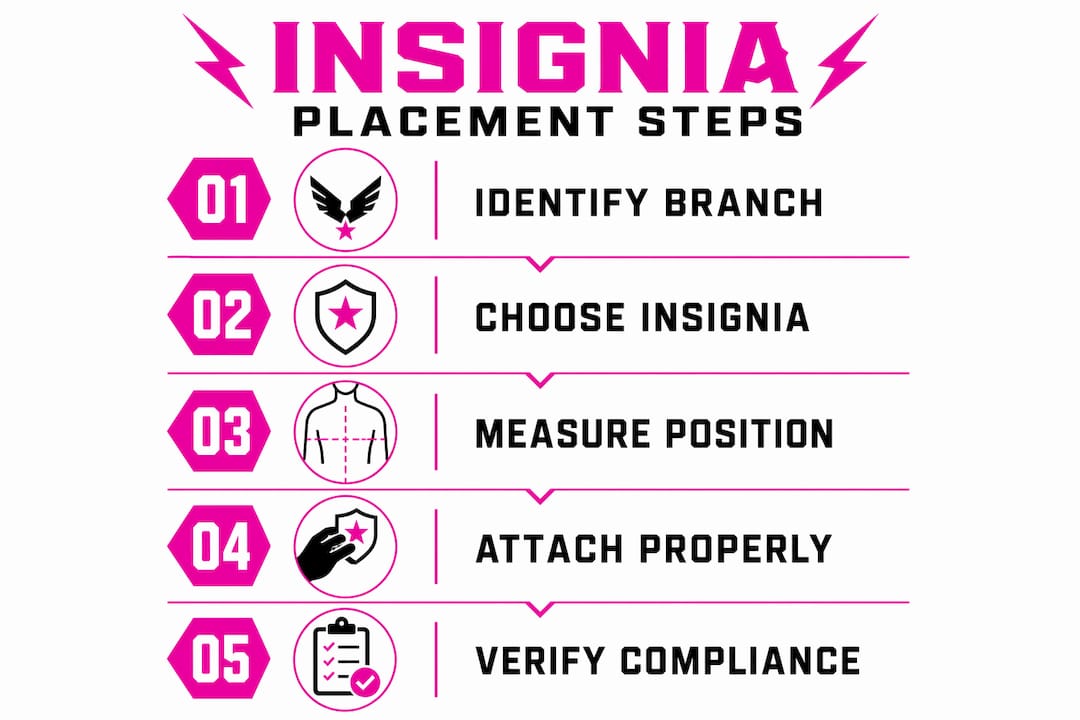
Exact placement of branch insignia on Army uniforms
Placement rules differ by uniform type, rank category, and gender. Getting the measurements right is not optional. Improper placement constitutes a uniform regulation violation under AR 670-1.
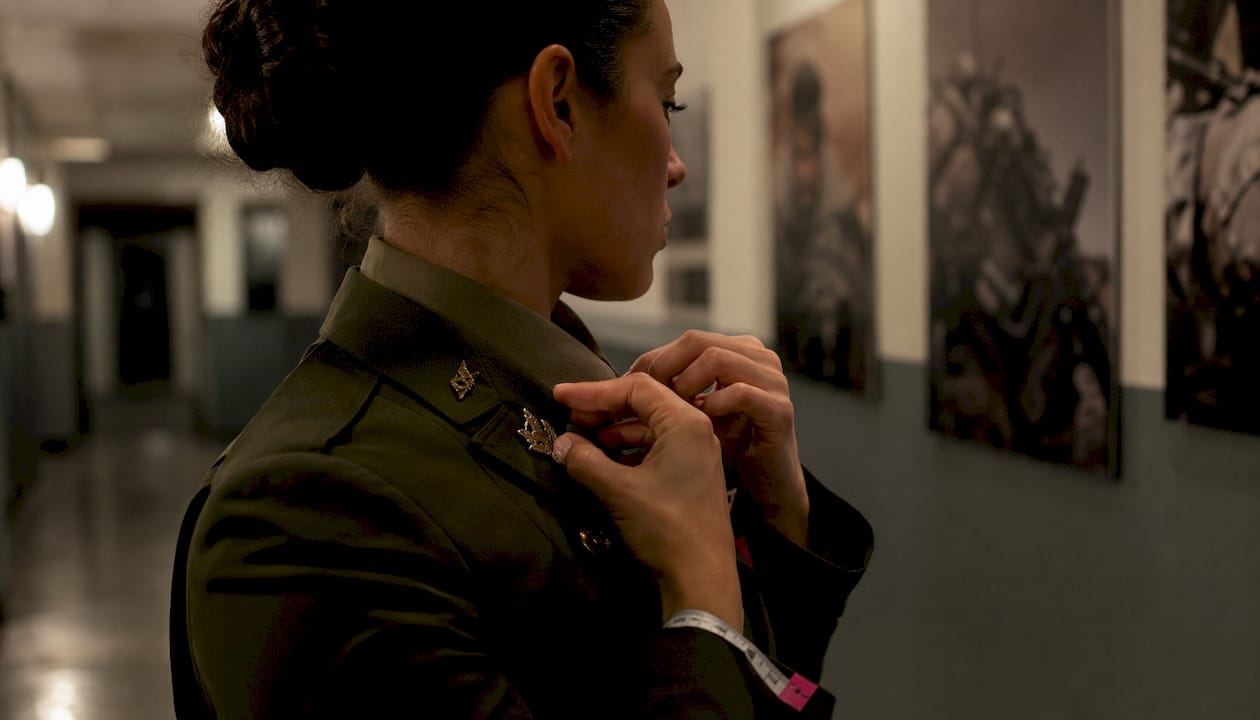
ASU placement by category
| Personnel Category | Uniform Location | Measurement Standard |
|---|---|---|
| Officers (all genders) | Both lapels, centered | 1¼ inches below U.S. insignia |
| Male enlisted | Left collar, centered | 1 inch above the collar notch |
| Female enlisted | Left collar, centered | 5/8 inch up from the collar seam |
| Warrant officers | Both lapels, centered | Same as commissioned officers |
ACU and IHWCU placement
The Army Combat Uniform and Improved Hot Weather Combat Uniform are the standard daily work uniforms as of 2026. Branch insignia on these uniforms uses subdued embroidered patches or pin-on metal devices, depending on the specific uniform configuration authorized by the unit. Placement follows collar tab positioning as specified in AR 670-1, with the insignia centered on the appropriate collar tab.
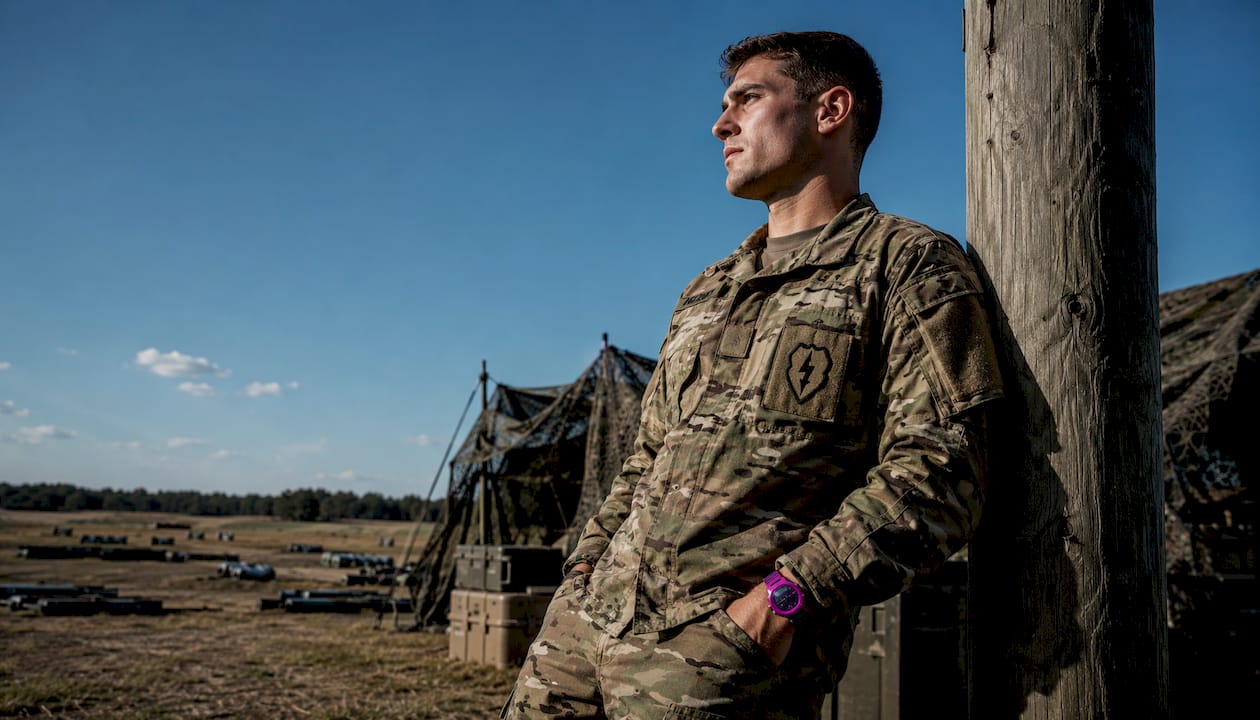
Army Directive 2026-16 modified chaplain insignia wear on the ACU specifically, removing rank from the ACU configuration and elevating branch insignia prominence on daily duty uniforms. Chaplains and unit administrators should verify current placement diagrams in the updated directive before assuming prior configurations remain valid.
Step-by-step placement for enlisted personnel on the ASU
- Lay the ASU coat flat on a clean surface with the left collar facing up.
- Identify the collar notch, the V-shaped point where the lapel meets the collar.
- For male personnel, measure 1 inch directly above the notch and mark the center point.
- For female personnel, measure 5/8 inch up from the collar seam and mark the center point.
- Attach the branch insignia centered on the marked point, with the device sitting flat against the fabric.
- Verify the insignia does not overlap the U.S. insignia or any other authorized device.
- Check that the insignia is secure and the backing fastener is fully closed.
Pro Tip: Use a small ruler or tailor’s tape when setting insignia for the first time on a new uniform. Eyeballing the measurement is the most common source of placement errors during inspections.
Why branch insignia carry the weight they do
Branch insignia in the U.S. Army trace their formal use to the 19th century, when the Army standardized devices to distinguish soldiers by function and specialty. The system predates modern occupational classification by decades.
Key points in the historical record:
- Early standardization: The Army began formalizing branch insignia in the 1830s, initially to distinguish artillery, infantry, and cavalry on the battlefield.
- Civil War expansion: The conflict accelerated the need for clear branch identification across a rapidly expanding force, pushing insignia design toward the distinctive crossed-rifles and crossed-cannons formats still recognizable today.
- 20th-century evolution: Both World Wars prompted new branches and new insignia, including the creation of devices for the Signal Corps, Chemical Corps, and later the Aviation branch.
- Modern specialty branches: The Army’s shift toward functional specialization in the late 20th century produced insignia for branches like Cyber, reflecting the force’s evolving mission set.
- Esprit de corps function: Branch insignia serve as a daily visual marker of professional identity. A soldier wearing Infantry crossed rifles or Medical Corps caduceus signals not just a job title but a body of training, doctrine, and tradition.
Branch insignia also reflect unit cohesion in a concrete way. When soldiers in the same branch see matching devices across a formation, it reinforces shared standards and mutual accountability. The device is small, but its presence on the uniform carries institutional weight that goes back nearly two centuries.
Special cases and exceptions you need to know
Several categories of soldiers operate under rules that differ from the standard framework. These exceptions are not informal. They are codified in AR 670-1 and enforced through the same channels as any other uniform standard.
- Basic trainees: Wear U.S. insignia on both collars. Branch insignia is prohibited until the soldier completes initial entry training and receives a PMOS designation.
- Nominative CSMs and SGMs: Wear nominative senior enlisted leader collar insignia in place of standard branch insignia. This applies only when the soldier is serving in a nominative position as designated by Headquarters, Department of the Army (HQDA).
- Sergeant Major of the Army: Wears Sergeant Major of the Army insignia in lieu of branch insignia entirely.
- Senior Enlisted Advisor to the Chairman (SEAC): A CSM appointed as SEAC wears SEAC insignia instead of branch insignia.
- General officers: May wear branch insignia at their option. The Chief of Staff, former Chiefs of Staff, and five-star generals may prescribe their own branch insignia. All other general officers who choose to wear branch insignia wear the insignia for the position to which they are appointed or their duty assignment.
- Chaplains: Subject to updated placement rules under Army Directive 2026-16, which removed rank from the ACU configuration and modified how branch insignia appears on daily duty uniforms.
- Aides-de-camp: Follow specific placement and insignia wear rules tied to the general officer they serve, as detailed in AR 670-1.
“Nominative CSMs and SGMs will wear nominative senior enlisted leader collar insignia (previously referred to as CSM insignia); worn by CSM and SGM when in a nominative position as designated by HQDA.” — AR 670-1, paragraph on enlisted branch insignia exceptions
These exceptions exist for operational and institutional reasons, not as discretionary choices. A nominative CSM who wears standard branch insignia instead of the designated nominative device is out of compliance, regardless of prior practice.
Official uniform wear vs. civilian branch insignia apparel
Branch insignia on official Army uniforms and branch insignia on civilian clothing are two entirely separate categories. The first is a regulatory requirement with specific placement rules, authorized materials, and enforcement consequences. The second is personal expression, with no connection to military uniform codes.
AR 670-1 governs only official Army uniforms. It does not regulate what veterans, enthusiasts, or off-duty service members wear on civilian clothing. Wearing a branch-themed shirt, jacket, or accessory in civilian life is not a uniform violation. It is simply not a uniform.
Common misconceptions worth correcting:
- Misconception: Wearing branch insignia on civilian clothing violates AR 670-1. Fact: AR 670-1 applies to official Army uniforms only. Civilian apparel falls outside its scope.
- Misconception: Veterans are prohibited from displaying branch affiliation on civilian clothing. Fact: Veterans may display branch pride on civilian apparel freely. No federal regulation prohibits it.
- Misconception: Decorative branch insignia on civilian clothing carries the same authority as uniform insignia. Fact: Civilian apparel with branch imagery is decorative. It carries no official status and confers no rank or authority.
- Misconception: Active-duty soldiers can wear branch insignia on any clothing item. Fact: Active-duty soldiers must follow AR 670-1 when in uniform. Off-duty civilian clothing is a separate matter governed by general appearance standards, not insignia placement rules.
Pro Tip: Veterans and enthusiasts who want to wear branch insignia apparel daily in civilian life should look for apparel that represents branch pride through design rather than attempting to replicate official uniform devices. Warbeardproject’s branch pride apparel covers exactly this distinction.
Improper wear of official insignia on a uniform, by contrast, carries real consequences. Soldiers found in violation of AR 670-1 placement or authorization rules may receive counseling statements, uniform violation notices, or adverse administrative action depending on the severity and frequency of the infraction. The regulation exists to maintain uniform discipline across the force, and commanders enforce it accordingly.
Service members who wear civilian gear off-duty operate under a different standard entirely. The Army’s general appearance guidelines ask that soldiers maintain a professional image even in civilian clothes, but this does not extend to regulating which branch-themed apparel they choose to wear.
Warbeardproject: branch pride apparel built for daily wear
Warbeardproject designs veterans lifestyle apparel for those who carry branch identity beyond the uniform. The brand’s apparel is built for daily civilian wear, not for parade grounds. If you’re a veteran, an active-duty soldier off-duty, or a military enthusiast who wants to wear branch insignia apparel daily without navigating AR 670-1, Warbeardproject’s line is the direct answer.
The New Logo Yoga Leggings from Warbeardproject bring the brand’s bold, graphic-forward aesthetic into everyday civilian apparel. Designed for comfort and built with the same attitude that defines the brand, they represent branch pride without the regulatory weight of a uniform device.
Veterans exploring financial resources alongside their apparel choices can also review home benefits for veterans through Movement Mortgage, a resource relevant to the broader veteran community Warbeardproject serves.
Key Takeaways
AR 670-1 governs all branch insignia wear on official Army uniforms, with specific placement measurements, authorization categories, and exceptions that apply to officers, enlisted personnel, and special cases including chaplains and nominative senior enlisted leaders.
| Point | Details |
|---|---|
| Authorization by category | Officers wear basic or detailed branch insignia; enlisted wear PMOS insignia; basic trainees wear U.S. insignia only. |
| ASU placement measurements | Officers: 1¼ inches below U.S. insignia on both lapels. Male enlisted: 1 inch above collar notch. Female enlisted: 5/8 inch from collar seam. |
| 2026 chaplain update | Army Directive 2026-16 modified chaplain insignia wear on the ACU, removing rank and elevating branch insignia prominence. |
| Nominative exceptions | Nominative CSMs and SGMs wear senior enlisted leader collar insignia, not standard branch insignia, per HQDA designation. |
| Civilian apparel distinction | Branch insignia on civilian clothing is personal expression, not regulated by AR 670-1, and carries no official status. |