

Military Uniform Evolution History Explained for Students
Military uniform evolution is the historical transformation from ornate, color-coded dress to functional combat wear driven by tactical necessity, weapons technology, and cultural identity. The military uniform evolution history explained across centuries reveals that what soldiers wear has never been arbitrary. Bright scarlet coats, drab khaki, frogskin camouflage, and today’s Operational Camouflage Pattern (OCP) each tell a precise story about the battlefield conditions and social values of their era. Standardization, material science, and the hard lessons of industrial warfare shaped every major shift. Understanding this timeline gives history enthusiasts and students a direct window into how armies think, fight, and define themselves.
How did military uniforms look and function before the 19th century?
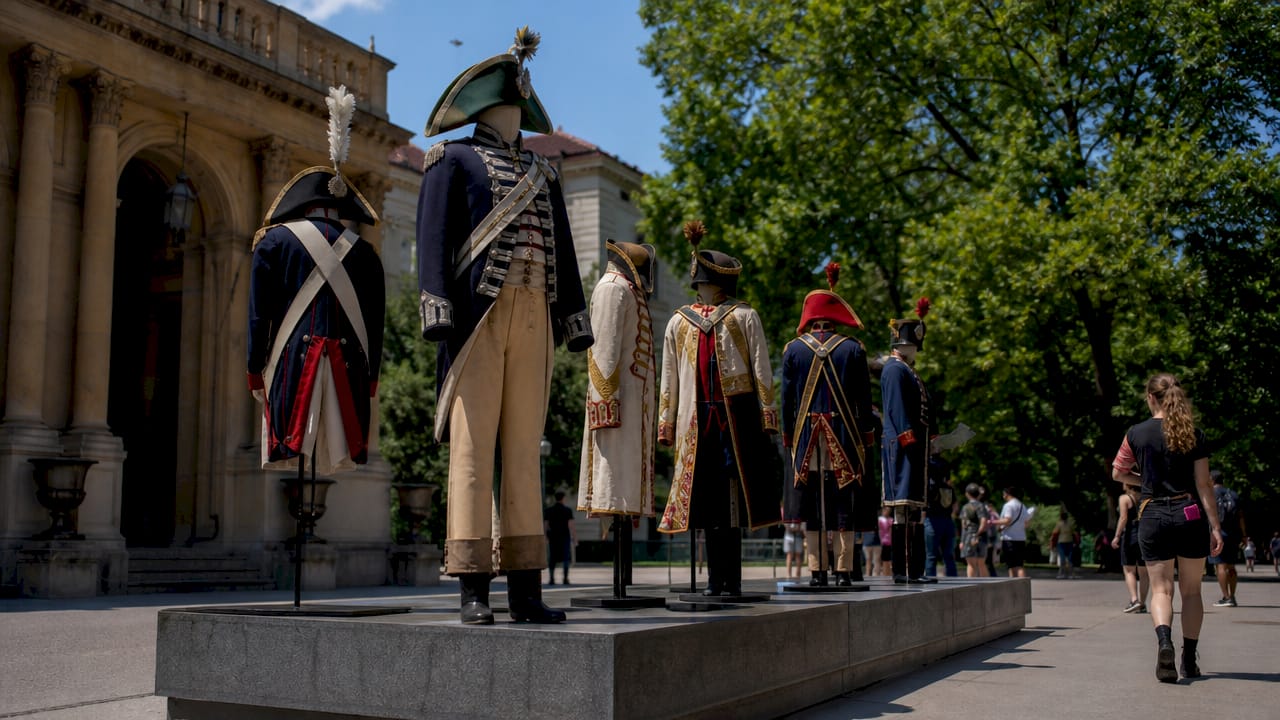
Pre-19th-century military dress was designed to be seen, not hidden. Armies relied on bright colors and elaborate ornamentation to distinguish friend from foe in the smoke and chaos of black-powder battles. At distances where muskets were effective, a soldier’s coat color was a critical identification tool.
The 18th-century European armies set the standard for this approach. British infantry wore scarlet coats with regimental facings in white, yellow, or blue to identify specific units. Prussian infantry wore Prussian blue. French regiments under the Grande Armée used white coats with colored lapels and shakos decorated with brass plates and plumes. These distinctions were not vanity. They were operational necessity on a battlefield where formations fought shoulder to shoulder.
Colorful dress uniforms in volunteer armies also served as powerful recruitment tools. A bright, well-cut uniform attracted men who might otherwise stay home. The psychological effect was real: a soldier who looked impressive felt impressive, and a unit with a strong visual identity fought with greater cohesion.
- Regimental colors identified units at a glance during battle
- Elaborate facings, epaulettes, and piping marked rank and branch
- Tall shakos and bearskin caps added visual height and intimidation
- Drummers and musicians wore reversed colors to stand out for signaling
- Dress standards reinforced discipline and unit pride off the battlefield
Pro Tip: When studying pre-19th-century uniforms, cross-reference regimental facing colors with order-of-battle records. The facing color often tells you exactly which regiment appears in a painting or photograph.
The significance of military dress in this era extended beyond the battlefield. Uniforms communicated social rank, national identity, and military power to civilian populations. A regiment marching through a town in full dress was a statement of state authority as much as a fighting force.
What triggered the shift from ornamental to utilitarian designs?
The shift from ornamental to utilitarian military dress began with a single technological fact: smokeless powder made soldiers visible at lethal range. Before the 1880s, black-powder battlefields were obscured by dense smoke within minutes of the first volley. That smoke provided cover. Smokeless powder removed it entirely.
Machine guns, breech-loading rifles, and artillery with greater accuracy followed. Soldiers wearing scarlet or white became targets at ranges exceeding 1,000 yards. The British Army learned this lesson painfully during the Second Boer War (1899–1902), where Boer marksmen in earth-toned clothing consistently outperformed British troops in red coats. The Army adopted khaki for field use almost immediately after.
| Era | Dominant color | Primary driver |
|---|---|---|
| Pre-1850 | Bright regimental colors | Unit identification, recruitment |
| 1850–1900 | Mixed, transitional | Rifle accuracy, colonial warfare |
| 1900–1918 | Khaki, grey, sky blue | Smokeless powder, machine guns |
| Post-1918 | Drab field colors | Trench warfare, aerial observation |
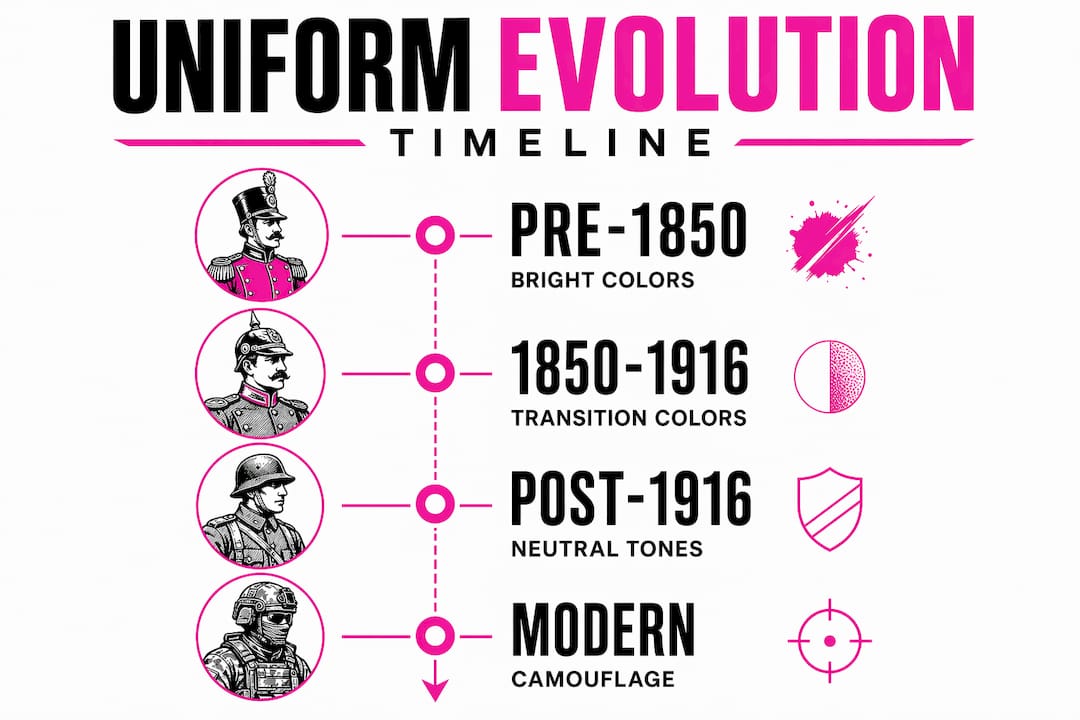
By 1916, nearly all major armies had adopted neutral colors like khaki, grey, or sky blue for frontline service. That shift was not gradual preference. It was survival. Armies that held onto bright colors suffered disproportionate casualties in the opening phases of World War I.
The decline of decorative dress for frontline troops did not erase color entirely. Ceremonial uniforms retained traditional features like piping, busbies, and regimental lace for parades and state occasions. The split between operational and ceremonial dress that exists today was born in this period.
Pro Tip: Compare photographs of the same army’s uniforms from 1900 and 1916 side by side. The visual contrast makes the tactical logic of the shift immediately obvious and works well as a classroom exercise.
Trench warfare added another pressure: uniforms needed to function in mud, rain, and cold for weeks at a time. Heavy wool held moisture and bred disease. The demand for practical, mass-producible, and durable field clothing accelerated changes that peacetime armies would have resisted for decades.
How did mid-to-late 20th-century conflicts shape uniform design?
World War II produced the first systematic use of environment-specific camouflage patterns. The U.S. Marine Corps introduced the frogskin reversible pattern in the Pacific theater, with a green side for jungle and a tan side for beach landings. German forces deployed the Splittertarnmuster (splinter pattern) and later the Leibermuster, both designed to break up the human outline in woodland terrain.
The Vietnam War era accelerated material and pattern innovation faster than any previous conflict. Jungle warfare demanded fabrics that dried quickly, resisted rot, and breathed in extreme humidity. Synthetic blends replaced heavy wool and cotton duck for jungle uniforms. This was a fundamental change in how armies thought about clothing: comfort and function became design requirements, not afterthoughts.
- The Tiger Stripe pattern, developed for South Vietnamese forces, used bold vertical stripes to mimic jungle shadow
- The ERDL (Engineer Research and Development Laboratory) pattern introduced in 1967 became the direct ancestor of later U.S. woodland camouflage
- Lightweight ripstop nylon replaced canvas in load-bearing equipment, reducing soldier fatigue
- Boot design shifted from leather to jungle boots with canvas uppers and drainage ports
- Velcro began replacing metal buttons and snaps for faster gear management in the field
The Cold War period saw NATO and Warsaw Pact armies develop parallel but distinct approaches. NATO forces generally favored disruptive pattern materials (DPM) with organic shapes. Soviet and Eastern Bloc forces used geometric patterns suited to their operational environments. Each choice reflected both tactical doctrine and available manufacturing technology.
The cultural impact of this era on the history of military uniforms is significant. Patterns like Tiger Stripe crossed into civilian fashion within a decade of their introduction. Veterans returning from Vietnam wore their field jackets as a statement of identity, a practice that directly influenced the veteran identity in apparel that continues today.
What characterizes modern military uniforms and their design philosophy?
Modern military uniform design treats the soldier as an athlete. The shift from Battle Dress Uniforms (BDUs) to Army Combat Uniforms (ACUs) in the early 2000s represented a philosophical change from parade-ready attire to modular, ergonomic combat systems. Every feature serves a specific function.
The U.S. Army’s initial ACU used the Universal Camouflage Pattern (UCP), a pixelated digital design. Field experience proved it ineffective. Digital camouflage like UCP failed in real environments because its rigid geometric structure did not mimic natural light and shadow. The Army replaced UCP with OCP, which uses organic shapes and a broader color range to match actual foliage.
- OCP adoption: The U.S. Army fully switched to OCP by october 2019. The Air Force adopted it in 2018. The pattern outperforms UCP across multiple terrain types.
- Ergonomic pocket design: Slanted chest pockets allow access while wearing plate carriers. Straight pockets become inaccessible under body armor.
- Mandarin collar: Replaces the traditional collar and tie combination, reducing friction points under body armor and helmet straps.
- Velcro fasteners: Speed gear attachment and removal but introduce audible noise that can compromise stealth. This trade-off is an active design consideration.
- Modular compatibility: Modern uniforms are designed to work with plate carriers, hydration systems, and communications equipment as an integrated system.
| Uniform category | Formality level | Primary use |
|---|---|---|
| Full Dress | Equivalent to white-tie civilian | State ceremonies, formal parades |
| Service Dress | Business formal equivalent | Administrative, garrison duty |
| Combat/Field | Functional, climate-specific | Operational deployments |
Full Dress uniforms equate in formality to white-tie civilian dress. Combat uniforms use lightweight, synthetic, and modular fabrics optimized for the operational environment. The gap between these two categories has never been wider, and that gap itself tells the story of how warfare changed.
How do military uniforms reflect cultural and social values?
Military uniforms carry meaning far beyond their physical function. A uniform communicates belonging, sacrifice, rank, and national identity simultaneously. That symbolic weight has been present since the first standardized military dress and remains intact today.
The role of colorful uniforms in volunteer armies as recruitment and morale tools shows that dress has always served psychological purposes. A man who enlisted partly because of a regiment’s impressive appearance was more likely to identify with that unit and fight harder to protect its reputation. Esprit de corps is not an accident. It is engineered, and uniform design is one of the tools.
- Ceremonial uniforms preserve regimental traditions that connect modern soldiers to historical predecessors
- Color and insignia communicate rank hierarchies that structure military organizations
- Uniform standards enforce discipline and collective identity across diverse individuals
- Veterans carry uniform symbolism into civilian life through military-inspired apparel and insignia
- National flags and unit patches on modern uniforms serve the same identification function as 18th-century facing colors
The military outfit historical timeline shows a consistent pattern: when armies shift their uniforms, they signal a shift in values. The move to khaki signaled that survival mattered more than spectacle. The move to OCP signaled that field effectiveness mattered more than institutional uniformity across branches. Each change is a policy statement made in fabric and thread.
Modern forces balance heritage preservation with operational necessity. The British Household Cavalry still rides in breastplates and plumed helmets for state occasions. The same soldiers deploy in OCP-equivalent MultiCam for combat operations. Both uniforms are authentic expressions of what the military is and what it does.
Key Takeaways
Military uniform evolution is a direct record of how warfare, technology, and cultural values changed across centuries, with each major shift in dress reflecting a specific tactical or social pressure.
| Point | Details |
|---|---|
| Color served function | Pre-19th-century bright colors identified units in black-powder smoke, not just for display. |
| Technology forced change | Smokeless powder and machine guns made high-visibility uniforms lethal by World War I. |
| Environment drove pattern design | Jungle, desert, and woodland warfare each produced specific camouflage patterns from WWII onward. |
| Modern design treats soldiers as athletes | OCP, slanted pockets, and modular compatibility reflect ergonomic priorities over parade aesthetics. |
| Uniforms encode cultural identity | Ceremonial dress preserves tradition while field uniforms reflect operational values of each era. |
Why uniform history is more than a footnote
Tracing the evolution of military attire is one of the clearest ways to read military history without reading a single battle account. Every design decision in a uniform reflects a specific problem someone had to solve under pressure. The shift to khaki was not a fashion choice. It was a response to body counts.
What strikes me most about this history is how slowly institutions change even when the evidence is overwhelming. The British Army knew bright red coats were dangerous in the Boer War. It took years of institutional resistance before khaki became standard. That pattern repeats: the U.S. Army fielded UCP knowing the science of camouflage, then spent over a decade correcting the mistake with OCP. Uniform history is also a history of bureaucratic inertia.
The details matter more than the broad strokes. The slanted chest pocket is a better teaching tool than any general statement about “modern ergonomic design.” It shows exactly how a specific problem, a soldier who cannot reach his pocket while wearing a plate carrier, produced a specific solution. That level of specificity is what separates genuine understanding from surface familiarity.
For students and history enthusiasts, the military outfit historical timeline rewards close attention. The closer you look at the details of what soldiers wore and why, the more you understand about the wars they fought and the societies that sent them.
— Ian
Warbeardproject: apparel rooted in military heritage
Warbeardproject builds apparel for veterans and military enthusiasts who understand that what you wear carries meaning. The brand draws directly from the tradition of military dress, where every design choice reflects identity, values, and experience.
If the history of military uniforms connects with you, Warbeardproject’s veterans lifestyle apparel carries that same respect for heritage into everyday wear. The brand is built by people who know what a uniform means. Every piece reflects that understanding. Visit Warbeardproject to find apparel that honors the military tradition without requiring an explanation.
FAQ
What is the military uniform evolution history explained in brief?
Military uniforms evolved from bright, color-coded regimental dress designed for battlefield identification into functional, camouflage-based combat systems driven by weapons technology and tactical necessity. By 1916, nearly all major armies had adopted neutral field colors.
Why did armies stop wearing bright colors in battle?
Smokeless powder, introduced in the 1880s, removed the battlefield smoke that previously obscured soldiers. Machine guns and accurate rifles made high-visibility uniforms lethal, forcing armies to adopt khaki, grey, and other drab colors for survival.
What is the Operational Camouflage Pattern (OCP)?
OCP is the camouflage pattern the U.S. Army adopted to replace the pixelated Universal Camouflage Pattern. The Army fully transitioned to OCP by october 2019 because its organic shapes better mimic natural foliage and light than digital pixel designs.
How did the Vietnam War change military uniform design?
The Vietnam War introduced synthetic fabric blends that dried quickly in jungle humidity, along with environment-specific patterns like Tiger Stripe and ERDL. These changes established the principle that field uniforms must match the specific climate and terrain of the operational environment.
Why do modern armies still use ceremonial dress uniforms?
Ceremonial uniforms preserve regimental traditions, support morale, and communicate institutional identity to civilian populations. They are operationally separate from combat dress and serve a psychological and diplomatic function that field uniforms cannot replace.