

What Does Battle Buddy Mean to Veterans?
What does “battle buddy” mean in the military?
A battle buddy is a fellow service member assigned to provide mutual support, both in and out of combat. The U.S. Army mandates this pairing during Basic Combat Training and Advanced Individual Training. The system is not optional, and it is not informal at that stage.
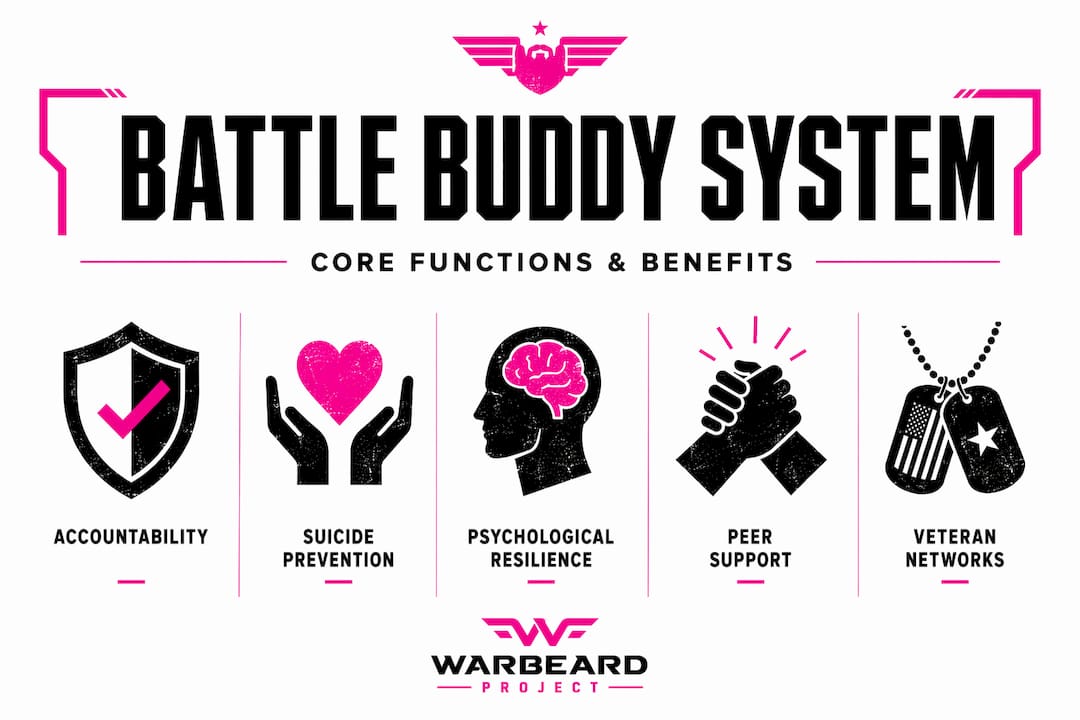
Core functions of the battle buddy role:
- Mutual accountability: Neither soldier moves alone. The pair monitors each other’s physical safety and conduct at all times.
- Emotional monitoring: Battle buddies watch for signs of distress, behavioral changes, or withdrawal that may signal a mental health crisis.
- Teamwork reinforcement: The pairing builds unit cohesion by forcing cooperation under pressure from day one.
- Suicide prevention: The system serves as a frontline, non-clinical intervention for identifying soldiers at risk.
- Practical support: Help with gear, tasks, and daily logistics is part of the role, not just the high-stakes moments.
The battle buddy definition is straightforward: one soldier, one partner, full mutual responsibility.
Table of Contents
- How the U.S. Army developed the battle buddy system
- How battle buddies reduce suicide risk and build psychological resilience
- How the battle buddy concept became part of veteran culture
- Why the battle buddy idea still matters for veterans and military enthusiasts
- How the battle buddy system works across military branches
- How allied militaries apply similar paired-accountability systems
- How the battle buddy system shapes veteran support networks after service
- Key Takeaways
How the U.S. Army developed the battle buddy system
The battle buddy system did not emerge from a single policy decision. It developed as a structured response to documented problems inside the force.
Key developments in the system’s history:
- The Army formalized the battle buddy program during initial entry training as a camaraderie-building measure.
- Military leadership expanded its use after identifying links between social isolation and increased misconduct and suicide risk.
- U.S. Army guidelines codified the requirement that soldiers remain paired throughout Basic Combat Training, rarely permitted to move alone.
- Early resistance was common. Soldiers initially resisted the system, viewing it as a loss of independence. That resistance typically faded as the practical value became clear under training stress.
- Commanders adopted the system as a dual-purpose tool: institutional risk reduction and individual emotional support.
The program’s expansion beyond initial training reflects how effective the structure proved when applied consistently.
How battle buddies reduce suicide risk and build psychological resilience
The battle buddy system was reinforced following a 37% increase in the U.S. Army suicide rate in 2006. By 2009, a significant number of Army suicides were recorded in a single year, accelerating the program’s expansion beyond training phases.
Psychological mechanisms behind the system’s effectiveness:
- Cortisol reduction: Clinical perspectives confirm that trusted peer support lowers stress hormone levels and reduces mood disorder risk.
- Isolation prevention: Isolation is a primary risk factor for suicide. Constant pairing structurally removes the conditions where isolation takes hold.
- Behavioral monitoring: Battle buddies are positioned to detect early warning signs before a crisis escalates to a point where clinical intervention is the only option.
- Non-clinical resilience: The system functions as a peer-based psychological tool, not a replacement for therapy, but a consistent layer of support between a soldier and a breaking point.
Statistic: The Army’s 2009 suicide data — 211 Army deaths in one year — directly drove the expansion of the battle buddy program into units beyond initial training. The numbers forced a structural response.
For veterans dealing with PTSD, peer accountability remains a critical complement to clinical care. Medical cannabis for PTSD is one area where veterans are also exploring additional support options alongside peer-based systems.
How the battle buddy concept became part of veteran culture
The battle buddy relationship does not end at the base gate. For most veterans, it follows them into civilian life as a cultural standard, not a regulation.
- The term has become cultural shorthand for any trusted comrade who has your back, regardless of whether active duty is involved.
- Veterans frequently report missing the peer accountability structure after leaving the military. The absence of that system is one of the sharper transitions in post-service life.
- Informal veteran networks replicate the battle buddy model through check-in habits, group activities, and direct peer accountability for personal goals.
- Warbeardproject recognizes this dynamic directly. The veteran brotherhood symbols that resonate most with the brand’s audience are rooted in exactly this kind of mutual accountability.
- Veterans carry the battle buddy mindset into career decisions, fitness habits, and social choices, applying the same peer monitoring logic they learned in uniform.
Why the battle buddy idea still matters for veterans and military enthusiasts
The battle buddy significance is not nostalgia. It is a functional framework for accountability, trust, and mental health that transfers directly to post-service life.
- Accountability structure: The military trained you to operate with a partner. Replicating that structure in civilian life produces measurable results in personal discipline.
- Mental health continuity: Peer support does not stop being effective after discharge. Veterans who maintain battle buddy-style relationships report stronger mental health outcomes.
- Identity and lifestyle: For military enthusiasts and veterans, the battle buddy concept is part of a broader identity. Apparel that reflects veteran brotherhood values carries that meaning visually.
- Suicide prevention beyond service: The peer monitoring function is just as relevant after discharge. Veterans face elevated suicide risk post-service, and informal battle buddy networks fill a gap that clinical systems often cannot reach fast enough.
- Cultural credibility: Understanding what battle buddy means signals authentic connection to military culture, not surface-level enthusiasm.
Pro Tip: If you left the military and lost that accountability structure, rebuild it deliberately. Identify one person who will check in on you consistently, and commit to doing the same for them. That is the battle buddy system in civilian form.
How the battle buddy system works across military branches
The U.S. Army owns the formal “battle buddy” terminology, but the underlying concept operates across all branches under different names and structures.
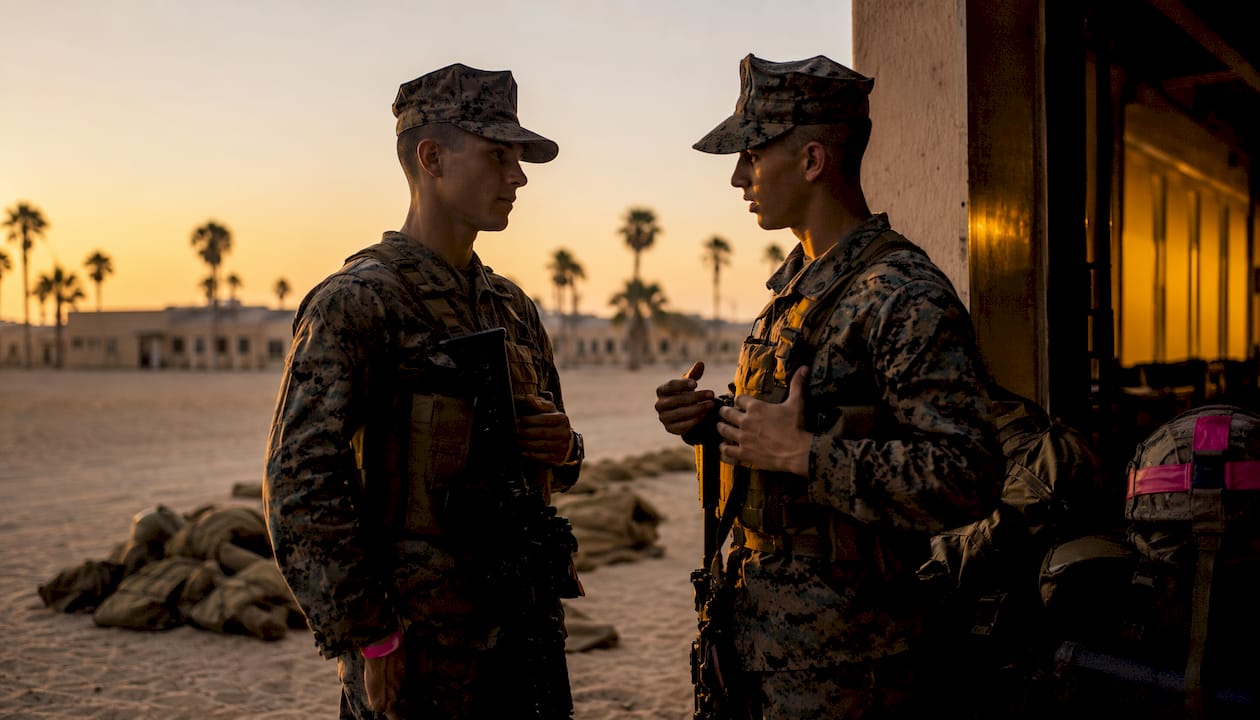
The Marine Corps uses the buddy system extensively in recruit training at Parris Island and MCRD San Diego. Marines are paired for accountability during initial training phases, with the expectation of mutual oversight carrying into unit culture.
The Navy applies a similar structure through its shipboard watch-standing culture, where sailors are rarely alone during high-risk operations. The “swim buddy” system in Navy SEAL training is one of the most rigorous applications of the concept anywhere in the U.S. military.
The Air Force and Space Force apply buddy-system principles during survival, evasion, resistance, and escape training, where paired accountability is a survival requirement, not a morale initiative.
The Army National Guard and Reserve components face a specific challenge: soldiers return to civilian environments between training periods, making the informal maintenance of battle buddy relationships harder to sustain but no less important.
How allied militaries apply similar paired-accountability systems
The battle buddy model is not uniquely American. Allied militaries have developed parallel systems reflecting the same core logic.
The British Army uses a “mucker” system, an informal but culturally entrenched pairing where soldiers look out for one another in training and on operations. The term predates the American battle buddy label by decades.
The Israeli Defense Forces embed paired accountability into unit structure from basic training forward. Given the IDF’s conscription model, the peer support function is especially critical for young soldiers entering service with no prior military exposure.
NATO partner forces across Europe apply buddy-system principles during joint exercises and deployments, often adopting U.S. Army battle buddy protocols when operating alongside American units.
The common thread across all these systems: isolation is the enemy, and structured pairing is the countermeasure.
How the battle buddy system shapes veteran support networks after service
Veterans who miss peer accountability after leaving the military are not experiencing a minor adjustment. They are losing a structural safety net that was built into their daily life for years.
Post-service veteran support networks that function well tend to replicate the battle buddy model, whether intentionally or not. Veteran service organizations, peer support groups, and community programs that pair veterans with accountability partners consistently outperform those that offer only information or benefits navigation.
Commanders used the system to reduce alcohol-related incidents and misconduct through enforced peer accountability. Veterans who carry that same accountability logic into civilian life apply it to career goals, fitness, and personal decisions. The mechanism transfers cleanly.
Financial stability is another area where veteran support networks apply battle buddy principles. Programs like VA home loans give veterans a structural advantage in building civilian stability, and peer networks help veterans navigate those options without falling through the cracks.
Warbeardproject builds apparel for veterans who carry this identity forward. The New Logo Yoga Leggings represent that same bold, no-apology aesthetic that defines veteran culture at its core.
Key Takeaways
The battle buddy system is a structured peer accountability model that reduces isolation, prevents suicide, and builds the mutual trust veterans carry into civilian life.
| Point | Details |
|---|---|
| Formal military origin | The U.S. Army mandates battle buddy pairing during Basic Combat Training and Advanced Individual Training. |
| Suicide prevention driver | A 37% rise in Army suicides in 2006 directly accelerated the system’s expansion across units. |
| Psychological mechanism | Peer support lowers cortisol levels and reduces mood disorder risk without replacing clinical therapy. |
| Post-service relevance | Veterans frequently report losing peer accountability after discharge, making informal battle buddy networks critical. |
| Cross-branch application | Every U.S. military branch applies paired-accountability principles, though terminology and structure vary. |