

Why Military Members Wear Subdued Colors: 2026 Guide
Military members wear subdued colors — muted, low-saturation earth tones — on combat and duty uniforms to minimize visual detection and reduce targeting risk in the field. The term “subdued” is the official military designation for this color category, covering shades like coyote brown, olive drab, and spice brown. These colors are not aesthetic choices. They are tactical requirements backed by uniform regulations, cognitive science, and decades of battlefield experience. Understanding why soldiers wear gray, tan, and green instead of bright insignia reveals a system built entirely around survival.
Why military members wear subdued colors: the tactical core
Subdued colors work because they match the visual signature of natural terrain. Muted, low-saturation earth tones mimic soil, dry grass, rock, and shadow. The human eye is wired to detect contrast and brightness before it detects shape. A bright patch of color in a neutral environment triggers immediate recognition. A subdued tone does not.
The 5Ss of camouflage — Shape, Shadow, Spacing, Surface, and Sudden movement — form the framework military doctrine uses to guide concealment. Subdued colors directly address two of these: Surface and Shape. A matte, earth-tone surface reduces shine, and a low-contrast color disrupts the outline of the human form against natural backgrounds. Both reduce the chance an enemy detects a soldier’s position.
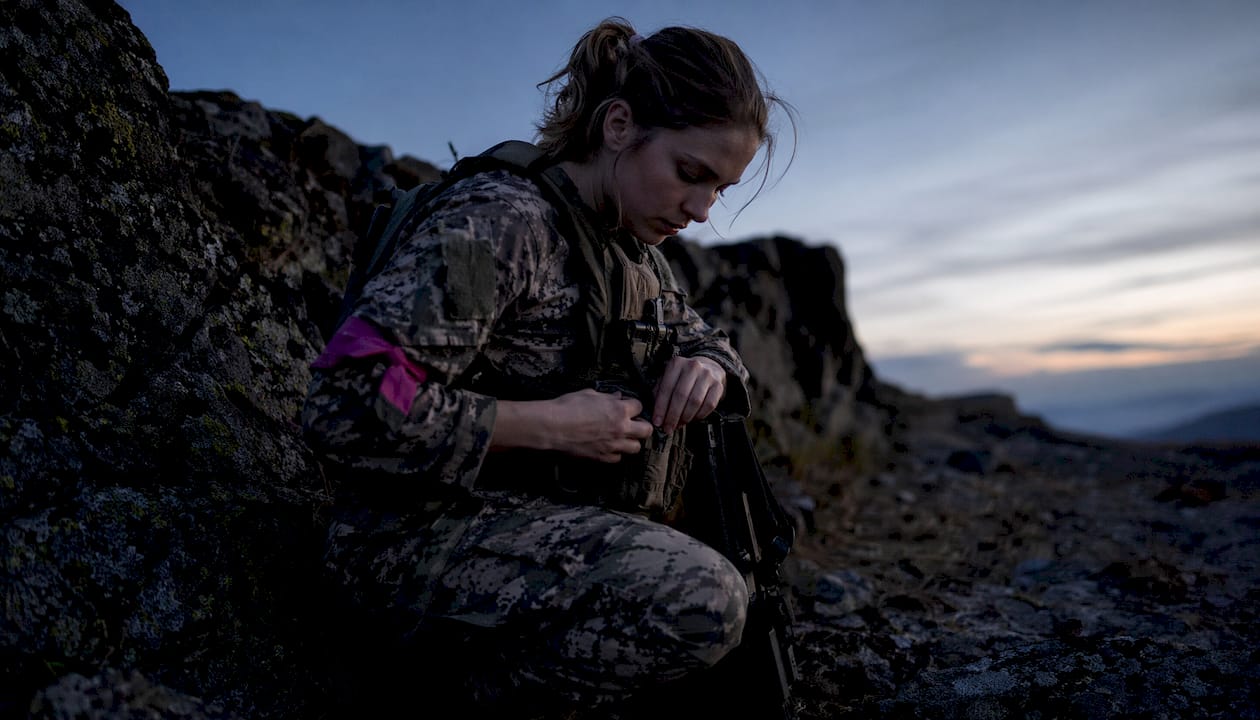
Color psychology reinforces this. Muted tones activate the parasympathetic nervous system, producing a calm, low-alert response in the observer. Bright, high-chroma colors do the opposite. They trigger the fight-or-flight response and draw the eye immediately. This means a soldier in subdued attire is not just harder to see. The observer’s own neurology works against detection.
Shine is a separate and underappreciated threat. Reflective glare from bright surfaces attracts attention even when color and shape are well-matched to the environment. This is why matte finishes and subdued embroidery on patches matter as much as the base color of the uniform. A perfectly camouflaged jacket with a shiny, full-color rank badge defeats the entire system.
Key subdued color palettes by environment:
- Woodland: Olive drab, dark green, brown, black
- Desert: Coyote brown, tan, sand, light gray
- Arctic: White, light gray, pale blue
- Urban: Gray, charcoal, muted tan
Pro Tip: In the field, even small reflective surfaces like watch faces, eyeglasses, and metal buckles can compromise camouflage. Subdued colors on the uniform are only one layer of a complete concealment system.
What are the official uniform rules for subdued insignia?
The U.S. military mandates subdued insignia on all field and duty uniforms. Full-color patches are reserved for ceremonial use only. Wearing a full-color patch on a combat uniform violates branch policy and can result in disciplinary action. The distinction is absolute, not a matter of personal preference.
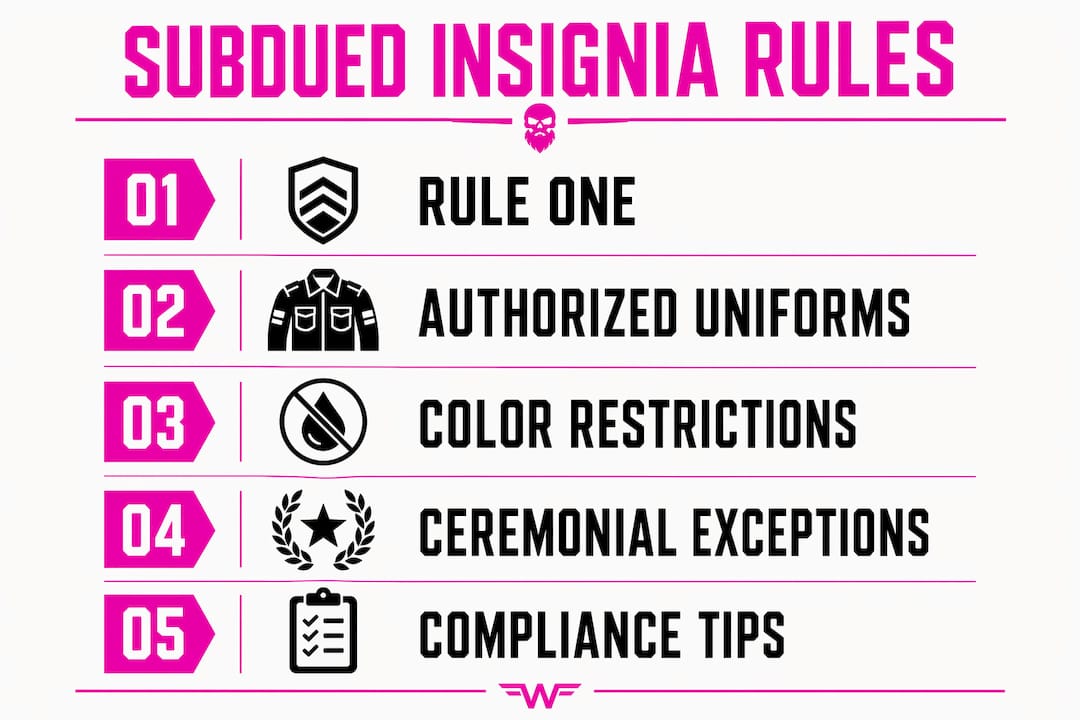
Each branch uses specific thread colors to maintain unit identity while preserving camouflage integrity. Army uniforms use coyote brown thread, Air Force uniforms use spice brown, and Space Force uniforms use space blue for rank and patch embroidery on the Operational Camouflage Pattern (OCP) uniform. These thread colors are low-contrast against the OCP base, keeping insignia visible to fellow service members at close range while remaining inconspicuous at distance.
The Army’s transition to the standardized OCP pattern was mandated by october 2019, replacing the earlier Army Combat Uniform pattern across the force. That deadline marked the completion of a years-long shift toward a single, versatile camouflage system. The OCP pattern itself uses a mix of tan, brown, and green tones designed to perform across multiple terrain types rather than one specific environment.
- Identify the uniform type. Field and duty uniforms require subdued patches and insignia only.
- Match thread color to branch. Army uses coyote brown, Air Force uses spice brown, Space Force uses space blue.
- Separate your insignia sets. Keep full-color patches for formal events and subdued patches for field wear.
- Use hook-and-loop correctly. Hook-and-loop fasteners allow quick removal of patches in the field, a safety feature built into uniform design.
- Never mix patch types. Mixing full-color and subdued insignia on the same uniform violates branch regulations and can trigger disciplinary review.
How did military uniform colors evolve over time?
Early military uniforms were designed for visibility, not concealment. Bright red coats, white crossbelts, and polished brass buttons served a purpose on pre-industrial battlefields where commanders needed to identify their troops at a distance and maintain unit cohesion through visual signals. Concealment was not a priority when musket range was short and battles were fought in open formations.
Rifled weapons changed everything. As accurate long-range fire became standard in the late 19th century, bright uniforms became liabilities. The British Army’s adoption of khaki in India during the 1840s and 1850s was one of the first deliberate shifts toward concealment-based uniform design. The U.S. Army followed with olive drab in the early 20th century, and the logic has driven uniform development ever since.
The major milestones in military color evolution:
- Pre-1850s: Bright colors for unit identification and command visibility
- 1850s–1900s: Khaki and drab tones adopted for colonial and open-terrain warfare
- World War I and II: Olive drab and field gray become standard across major armies
- Vietnam era: Jungle camouflage patterns introduce multi-tone concealment
- 1980s–2000s: Digital camouflage patterns like MARPAT and ACU replace single-color uniforms
- 2019–present: OCP becomes the U.S. Army standard, designed for versatility across diverse terrains rather than one environment
The shift from single-color uniforms to multi-tone digital patterns reflects a direct response to improved battlefield detection technology. Night vision, thermal imaging, and aerial reconnaissance made single-color concealment insufficient. Modern camouflage patterns use color, pattern, and texture together to break up the human silhouette across multiple detection methods.
Bright colors did not disappear entirely. They moved to ceremonial uniforms, dress blues, and formal occasions where visibility signals rank, tradition, and institutional identity. The military attire colors worn in the field and the colors worn at a formal ceremony serve completely different purposes, and the distinction is deliberate.
What are the benefits of subdued colors beyond concealment?
Subdued colors reduce wearer fatigue in ways that go beyond the tactical. Lower saturation colors are easier for the brain to process, making muted tones “visually silent” compared to high-chroma colors. A service member wearing subdued attire in a natural environment experiences less visual conflict between their clothing and their surroundings. This reduces a subtle but real form of cognitive stress over long operations.
The psychological impact extends to unit cohesion. Uniform color standardization removes visual hierarchy based on appearance and reinforces collective identity. Every soldier in the same subdued OCP pattern reads as part of the same unit. That visual uniformity has a documented effect on group cohesion and shared purpose.
Additional benefits of subdued military attire colors:
- Reduced shine: Matte finishes on subdued patches and insignia eliminate reflective glare that attracts attention
- Shape disruption: Low-contrast colors prevent the human outline from standing out against natural backgrounds
- Thermal management: Darker earth tones absorb less direct sunlight than black, reducing heat load in desert environments
- Psychological calm: Muted tones produce lower observer arousal, reducing the chance of triggering a threat response at distance
- Cultural identity: Subdued colors connect service members to a shared visual language that carries meaning beyond the uniform itself
The connection between subdued colors and veteran identity extends well past active service. Veterans who wore these colors in the field often carry a strong association between earth tones and the discipline, focus, and purpose of military life. That association shapes clothing choices long after separation from service.
Pro Tip: Proper uniform care preserves subdued color effectiveness. Washing OCP uniforms with harsh detergents or bleach degrades the dye and can create uneven color patches that reduce camouflage performance. Use cold water and mild detergent to maintain color integrity.
Understanding the role of military tradition in apparel helps explain why subdued tones appear so consistently in veteran lifestyle clothing. The colors carry meaning that goes beyond fashion.
Key Takeaways
Military members wear subdued colors because muted earth tones reduce visual detection, comply with branch regulations, and carry deep cultural significance that extends from the battlefield to veteran identity.
| Point | Details |
|---|---|
| Tactical concealment | Subdued earth tones match natural terrain and disrupt human visual detection patterns. |
| Shine elimination | Matte finishes on patches and insignia remove reflective glare, a separate detection risk from color alone. |
| Uniform regulations | U.S. branches mandate subdued insignia on field uniforms; full-color patches are for ceremonial use only. |
| Historical evolution | Military uniform colors shifted from bright to muted as long-range weapons made visibility a liability. |
| Psychological impact | Muted tones reduce observer arousal and wearer cognitive stress, adding a non-visual layer to concealment. |
The colors that kept people alive
Subdued colors are one of those military details that look simple on the surface and reveal serious depth the closer you look. I’ve spent time around veterans and military history, and the thing that strikes me most is how little of this is arbitrary. Every shade, every thread color, every matte finish exists because someone learned the hard way what happens when it’s wrong.
The balance between tradition and tactical necessity shows up clearly in how the military handles color. Bright dress blues and ceremonial uniforms are not a contradiction of the subdued field uniform. They are a deliberate separation of two different functions. One says “we are here, we are proud, we represent something.” The other says “you cannot see us.” Both are correct in their context.
What I find underappreciated is the psychological layer. The camouflage color psychology argument usually stops at “it blends in.” But the effect on the wearer matters too. Wearing colors that match your environment creates a kind of cognitive alignment. You feel less exposed. That matters on a long patrol. It matters in training. It matters in the way veterans describe feeling more comfortable in earth tones long after they leave service.
The tactical clothing choices veterans make after separation are not nostalgia. They are a continuation of a color language that was built around survival and purpose. That is worth understanding.
— Ian
Warbeardproject: military heritage in every design
Warbeardproject builds apparel that reflects the values and visual language of military service. The New Logo Yoga Leggings carry that heritage in their design, using subdued color principles drawn from uniform tradition. Every purchase supports veteran nonprofits and keeps military culture visible in everyday life.

Warbeardproject connects the significance of muted tones and military attire colors to apparel built for people who understand what those colors mean. The designs are not decorative. They reflect a culture of discipline, identity, and service that veterans carry with them. Explore the full collection at Warbeardproject and find apparel that honors that tradition.
FAQ
Why do soldiers wear muted colors instead of bright ones?
Soldiers wear muted, subdued colors because low-saturation earth tones blend with natural terrain and avoid triggering human visual detection. Bright colors create contrast that the eye identifies immediately, increasing targeting risk.
What does “subdued” mean in military uniform terms?
“Subdued” is the official military designation for muted, low-contrast insignia and patches worn on field and duty uniforms. These replace full-color versions to reduce visibility during operations.
Which colors does each U.S. military branch use on OCP uniforms?
The Army uses coyote brown thread, the Air Force uses spice brown, and the Space Force uses space blue for rank and patch embroidery on OCP uniforms. Each branch maintains identity while preserving camouflage integrity.
Can service members wear full-color patches on combat uniforms?
Full-color patches are reserved for ceremonial uniforms only. Wearing them on a combat or duty uniform violates branch policy and can result in disciplinary action.
Why do veterans often prefer earth-tone clothing after service?
Veterans associate subdued earth tones with the discipline and purpose of military life. That color language becomes part of personal identity and continues to influence clothing choices long after separation from service.