

What "22 a Day" Really Means: Origin, Accuracy, and Help
“22 a day” is an advocacy shorthand rooted in a 2010-era VA estimate, not a precise, real-time daily count of veteran suicides. The figure originated from a 2012 VA Suicide Data Report that calculated approximately 22.2 veteran suicides per day based on death records from 21 states. More recent VA analyses report a lower daily equivalent. If you or someone you know is in crisis right now, contact the Veterans Crisis Line: call 988 and press 1, or call 1-800-273-8255 and select the veteran option.
Crisis resource: The Veterans Crisis Line also accepts texts (838255) and online chat at VeteransCrisisLine.net. Do not wait.
Key Takeaways
The “22 a day” figure is an advocacy shorthand from a 2012 VA estimate based on partial-state data; the most recent VA report puts the 2020 daily equivalent at approximately 16.8, and veterans still face higher suicide rates than non-veteran adults.
| Point | Details |
|---|---|
| Origin of “22 a day” | The figure came from a 2012 VA report estimating 22.2 veteran suicides per day based on 21-state data for 2010. |
| Current VA figure | The 2022 VA report documented approximately 16.8 veteran suicides per day in 2020, a decline of 343 from 2019. |
| Why the number changed | Expanded NDI coverage, all-50-state data, and a narrower veteran population definition all lowered the daily average from the original estimate. |
| Limitation of a daily average | A single daily figure masks age, cohort, and demographic differences; younger veterans and rural veterans face disproportionately elevated risk. |
| Where to get help now | Call 988 and press 1, or text 838255 to reach the Veterans Crisis Line at any time. |
Table of Contents
- What does “22 a day” mean, and where did it come from?
- What the VA reports actually said over time
- Why treating “22 a day” as a precise fact creates problems
- What the most recent VA data show
- Why advocates still use “22 a day” and what that costs
- What to do if you or someone you know is struggling
- Why Warbeardproject covers this topic
- Sources
What does “22 a day” mean, and where did it come from?
The phrase entered public discourse around 2012 and spread rapidly through veteran advocacy networks. Its origin is a single line in a VA report: an estimate that approximately 22.2 veterans died by suicide each day in 2010. That number came from partial-state data, not a nationwide count, but its specificity made it memorable and repeatable.
Key milestones in the phrase’s history:
- 2010 (data year): VA analyzes death records from 21 states to estimate national veteran suicide rates.
- 2012 (report release): The VA Suicide Data Report publishes the 22.2/day estimate, covering approximately 55% of the U.S. veteran population.
- 2012–2014: Media outlets pick up the figure. The phrase “22 a day” begins circulating in veteran communities and on social media.
- 2013–2014: Advocacy organizations, including 22 Vets A Day, adopt the number as a campaign anchor. The phrase “22 too many” follows shortly after.
- 2014–2015: The 22 Pushup Challenge launches on social media, asking participants to do 22 pushups for 22 days to raise awareness. The campaign reaches millions of views.
Advocates favored the number for a straightforward reason: a concrete figure is more persuasive than a range or a rate per 100,000. “22 a day” fits a tweet, a T-shirt, and a fundraising headline. That utility explains why the number persisted even as the underlying VA methodology changed.
What the VA reports actually said over time
The 22/day figure was never meant to be a permanent headline. VA methodology evolved significantly between 2012 and 2022, and each update changed the reported daily equivalent.
How the VA calculates a “per day” figure
VA researchers take the total number of veteran suicides recorded in a given year and divide by 365. For example: 6,132 veteran suicides in a year equals approximately 16.8 per day. The complication is that “total veteran suicides” depends on two variables: which states contributed data, and how “veteran” is defined. Both changed across report cycles.
How methodology changes shifted the numbers
Major updates that affected reported averages:
- 2012 report: Based on 21-state death certificate data. Broad veteran definition. Produced the 22.2/day estimate for 2010.
- 2019–2020 reports: Refined population definitions to separate veterans from active-duty, National Guard, and Reserve members. This narrowed the count and lowered the daily average.
- 2020 Annual Report: Recalculated prior years under the updated methodology. The adjusted 2010 equivalent came out lower than 22/day, reflecting fuller state coverage and the revised population definition.
- 2022 Annual Report: Reported 6,146 veteran suicides in 2020, equivalent to approximately 16.8/day. Documented a decline of 343 veteran suicides from 2019 to 2020.
The VA’s expanded data series covering 2005–2016 shows this pattern clearly: as NDI coverage improved and population definitions tightened, earlier headline averages were revised downward across the board.
Why treating “22 a day” as a precise fact creates problems
The number is not wrong in the sense of being fabricated. It is wrong in the sense of being outdated, partial, and often misread as a current, exact daily count. Several specific limitations apply.
- Partial-state coverage. The original estimate drew from 21 states, roughly 55% of the veteran population. A 21-state sample cannot produce a precise national figure; it produces an estimate with meaningful uncertainty.
- Averaging masks variation. Dividing annual totals by 365 produces a smooth daily figure that hides spikes, seasonal patterns, and differences across age cohorts. A veteran aged 18–34 and a veteran aged 65+ face very different risk profiles; a single daily average collapses both into one number.
- Population scope shifted. Early reports included active-duty, Guard, and Reserve members alongside veterans. Later reports separated these groups. Comparing a 2012 figure to a 2022 figure without noting this difference produces a false trend line.
- Data lag is structural. Because VA relies on the CDC’s NDI for mortality matching, published figures typically reflect data that is 2–3 years old. The most recent VA report covers 2020 data, published in 2022.
- Revision risk is real. NDI records are updated as late-arriving death certificates are processed. A figure published in one report may be revised in the next.
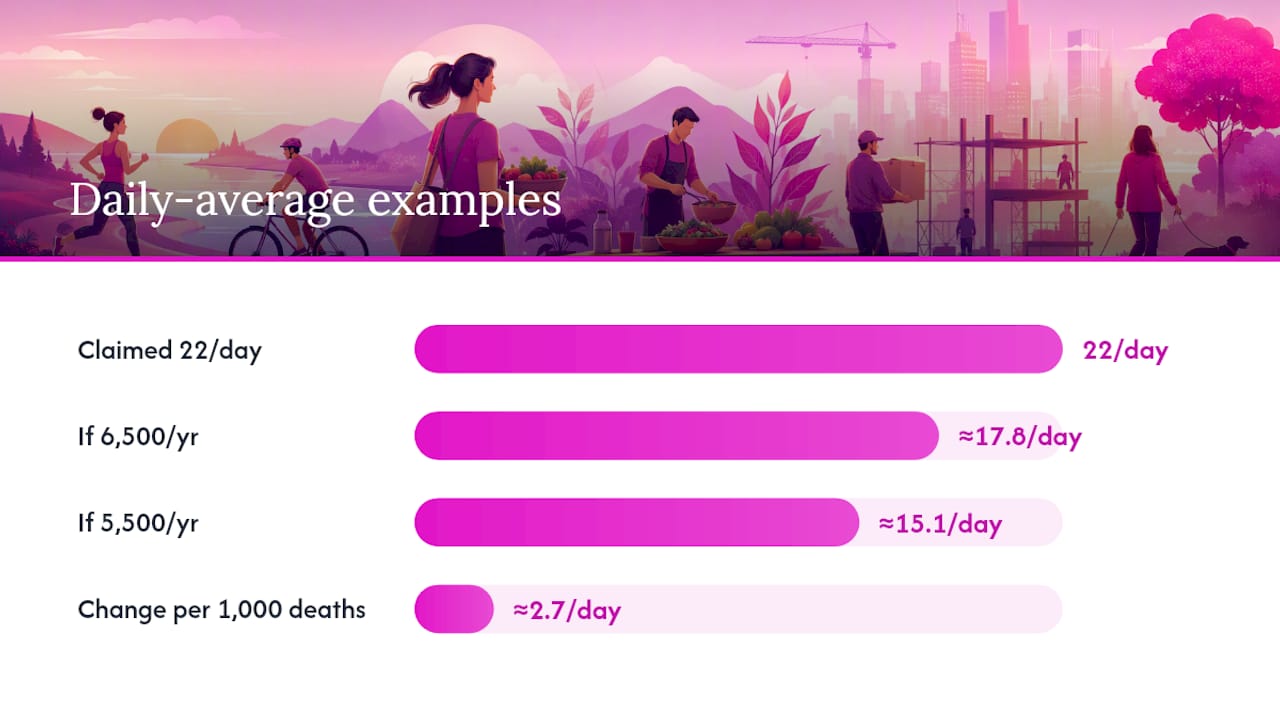
A short numeric illustration: if 6,500 veteran suicides occur in a year, the daily average is approximately 17.8. If 5,500 occur, it is approximately 15.1. A difference of 1,000 annual deaths changes the daily figure by about 2.7, yet both round to “roughly 17 a day.” The precision implied by “22 a day” is not present in the underlying data.
Pro Tip: When you encounter any suicide-rate headline, ask three questions: What year is the data from? Which population was counted? Was this a rate per 100,000 or a raw daily average? Those three answers determine whether two figures are actually comparable.
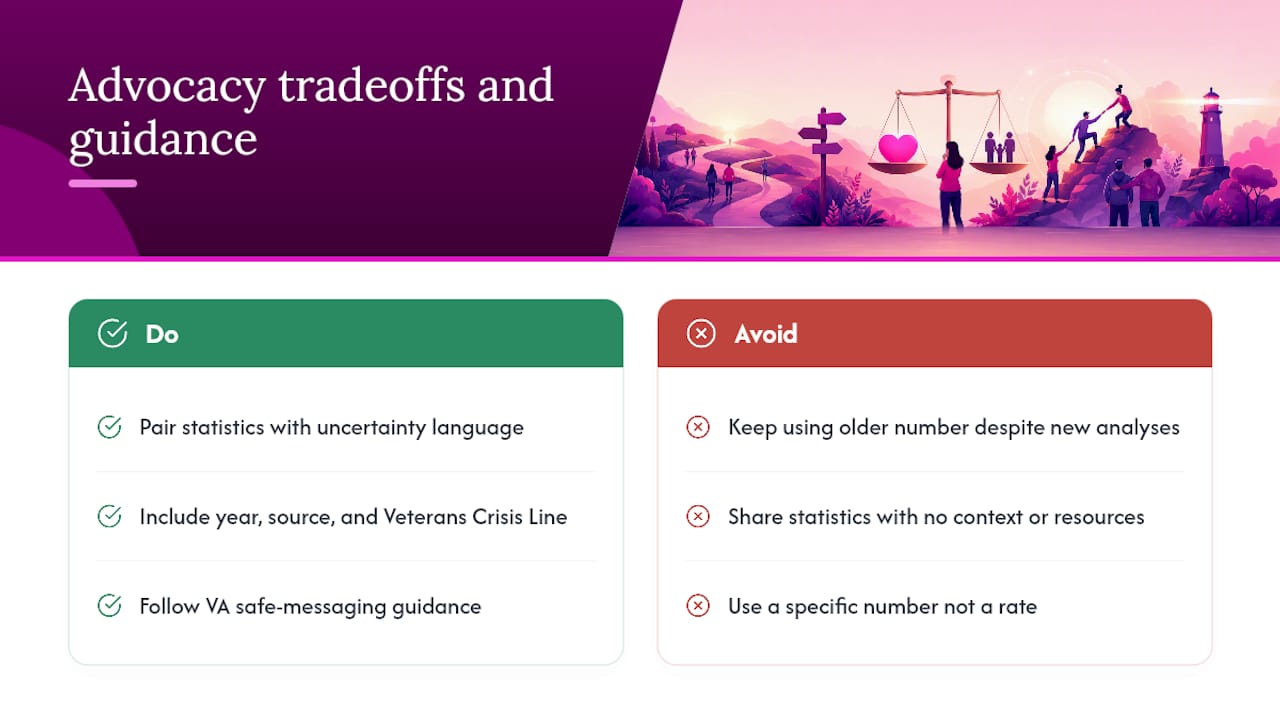
VA safe messaging guidance recommends pairing any statistic with contextual language about uncertainty and directing readers immediately to help resources, precisely because a bare number without context can distort perception.
What the most recent VA data show
The 2022 VA National Veteran Suicide Prevention Annual Report is the most current publicly available dataset as of this writing, covering 2020 deaths.
Key figure: The VA reported 6,146 veteran suicides in 2020, equivalent to approximately 16.8 per day. That is a decline of 343 from 2019, the largest single-year drop in the reporting period. Veterans still had a higher suicide rate than non-veteran U.S. adults after adjusting for age and sex.
The trend across recent years shows a gradual decline in raw counts, though the veteran-to-civilian rate gap has not closed. Younger veterans (18–34) and male veterans continue to show disproportionately elevated rates relative to their civilian counterparts. The 22/day figure does not reflect any of these subgroup differences.
A note on data lag: the 2022 report covers 2020 deaths. Any figures for 2021, 2022, or later are not yet publicly available from the VA. Treat any claim about “current” daily counts that exceeds what the 2022 report documents as unverified.
The demographic distribution matters practically. If public attention focuses on a single daily average, resources and outreach may not reach the subgroups at highest risk. Younger veterans, veterans with co-occurring substance use disorders, and veterans in rural areas with limited VA access all face elevated risk that a single headline number cannot capture. Integrated dual diagnosis treatment programs address exactly this overlap between mental health and substance use, which is relevant for veterans navigating both conditions simultaneously.
Why advocates still use “22 a day” and what that costs
The persistence of “22 a day” is a deliberate strategic choice, not an oversight. Advocacy organizations, including 22 Vets A Day, have built campaigns, merchandise, and fundraising infrastructure around the number. Changing it would require rebuilding that infrastructure and risking a loss of public recognition.
The logic is defensible. A specific number generates more donations, more media coverage, and more political attention than a rate per 100,000 or a confidence interval. The 22 Pushup Challenge reached audiences who had never engaged with veteran mental health before. That mobilization has real value.
NPR’s 2015 investigation documented both sides of this dynamic. The report found that the figure’s rhetorical power was real, but that its specificity could mislead the public about which veteran subgroups are most affected and about the genuine uncertainty in the underlying data. Advocates sometimes kept using the older number intentionally as a mobilizing tool even after more precise analyses produced different daily averages.
The concrete costs of that choice include misdirected resources, a public perception that the crisis is worse than current data show (which can itself contribute to stigma and hopelessness among veterans), and a weakened credibility when the number is publicly corrected. VA safe messaging guidance exists specifically to reduce these risks, recommending that organizations pair statistics with uncertainty language and immediate help resources.
Pro Tip: If you share veteran suicide statistics on social media or in a presentation, always include the data year, the source, and the Veterans Crisis Line number in the same post. A statistic without context and a resource is incomplete.
What to do if you or someone you know is struggling
Act on this before anything else. If there is immediate danger, call 911.
Veterans Crisis Line contacts:
- Call 988, then press 1 (veteran option)
- Call 1-800-273-8255, then press 1
- Text 838255
- Chat at VeteransCrisisLine.net
Steps to take when someone is at risk:
- Stay with the person. Do not leave them alone if they have expressed suicidal thoughts or intent.
- Remove access to means if it is safe to do so. Secure firearms, medications, and other items. This is one of the most effective single interventions available.
- Call the Veterans Crisis Line or 911 if there is immediate danger. Do not wait to see if the situation improves.
- Contact a VA provider or primary care team the next business day to report the crisis and request a safety plan review.
- Use SAMHSA’s community resources to locate local mental health programs, crisis stabilization units, and peer-support services.
- Reach out to VA REACH programs at Va for community-based outreach and provider support.
- Read guidance on supporting someone directly at Warbeardproject’s resource post on supporting a friend or relative who is feeling suicidal.
If the veteran is resistant to calling a crisis line, a peer-support approach through a trusted fellow veteran can lower the barrier. The battle buddy concept is built on exactly this principle: a trusted peer who checks in and stays present is often more effective than a formal referral as a first step. Long-term recovery also depends on sustained community support, not just crisis intervention, so connecting veterans to ongoing programs matters as much as the immediate response.
Why Warbeardproject covers this topic
At Warbeardproject, we make veteran-themed apparel and lifestyle gear. That is the product. The mission underneath it is different: a portion of every sale goes toward veteran outreach programs, and the content we publish is meant to give the veteran community accurate, usable information rather than emotional headlines.
“22 a day” is a phrase that appears on shirts, in hashtags, and in fundraising campaigns. We sell to the community that uses that phrase. That means we have a responsibility to explain what it actually means, where it came from, and what the current data say, rather than repeating a number that has not been accurate for over a decade.
Our veteran nonprofit apparel partnerships connect purchases directly to organizations doing on-the-ground work. The American veterans and suicide resource post on this site goes deeper on support structures and transition resources. Neither replaces professional mental health care, but both reflect a commitment to accuracy and to the community we serve.
Sources
The figures and claims in this article draw from the following primary sources. Data lag means VA figures typically reflect deaths from 2–3 years prior; check each source directly for the most current release.
- Va
- Mentalhealth
- Mentalhealth
- The Number 22: Is There A ‘False Narrative’ For Vet Suicide? : NPR
- Samhsa
This article provides general information only and is not a substitute for professional mental health care. Verify current statistics directly with the VA or CDC, and consult a qualified provider for clinical guidance.