

POW/MIA Symbol Meaning: History, Law, and Display
The POW/MIA symbol is the national emblem of remembrance and the United States government’s formal commitment to accounting for every American prisoner of war and service member missing in action. Defined under 36 U.S.C. § 902 as “the symbol of our Nation’s concern and commitment to resolving as fully as possible the fates of Americans still prisoner, missing, and unaccounted for in Southeast Asia,” the flag carries legal weight that most observers do not realize when they see it flying below the Stars and Stripes.
The emblem’s core elements, as described by the U.S. Army Institute of Heraldry, break down as follows:
- Silhouette: A bust profile of a prisoner, communicating the human cost of captivity
- Watch tower with armed guard: Representing surveillance and confinement
- Barbed wire: Symbolizing physical imprisonment and separation
- “POW/MIA” lettering: Identifying the remembered populations — prisoners of war and those missing in action
- Motto “YOU ARE NOT FORGOTTEN”: A direct public promise to the families of those unaccounted for
The National League of Families of American Prisoners and Missing in Southeast Asia originated the flag, and the Department of Veterans Affairs displays it at VA medical centers nationwide as a standing acknowledgment of that commitment.
Key Takeaways
The POW/MIA symbol is a legally designated national accountability instrument, not merely a commemorative image, and its display is federally mandated at covered properties every day the U.S. flag flies.
| Point | Details |
|---|---|
| Core meaning | The flag represents the nation’s active commitment to accounting for Americans still prisoner, missing, or unaccounted for. |
| Legal status | Designated under 36 U.S.C. § 902 as a national symbol; display is federally required at specified locations since —, expanded in 2019. |
| Display etiquette | Flies directly below the U.S. flag on a single pole; must not exceed the U.S. flag in size; official flags sourced from GSA or the National League of Families for formal use. |
| Emblem integrity | Core elements — silhouette, watch tower, barbed wire, “POW/MIA,” and “YOU ARE NOT FORGOTTEN” — define the recognized symbol; alterations produce variants, not the official emblem. |
| Respectful reproduction | Use the official design, preserve the motto and letter order, and consider directing proceeds to a veteran or POW/MIA nonprofit when using the emblem commercially. |
Table of Contents
- What is the POW/MIA symbol meaning and where did it come from?
- What each design element of the emblem actually symbolizes
- What U.S. law says the flag officially represents
- When and how should the POW/MIA flag be displayed?
- Where you see the POW/MIA flag displayed today
- How to reproduce the POW/MIA emblem respectfully in apparel and products
- Common myths and accurate answers about the POW/MIA flag
- Why the POW/MIA emblem still carries weight today
- Sources
What is the POW/MIA symbol meaning and where did it come from?
The flag did not emerge from a government directive. It came from families.
Around 1971, Mary Hoff (known formally as Mrs. Michael Hoff), a member of the National League of Families, proposed that the organization adopt a distinct symbol to keep public attention on Americans still unaccounted for in Southeast Asia. The National POW/MIA Memorial & Museum credits Newt Heisley, a commercial artist and World War II veteran, with creating the design. Annin & Company, one of the oldest flag manufacturers in the United States, produced the first flags for the League’s distribution.
That origin matters. The symbol was not commissioned by Congress or the Pentagon. It was built by a nonprofit family organization and then adopted upward into federal law, which is the reverse of how most national symbols are created.
The timeline from grassroots design to federal statute moved steadily:
The VA’s historical account confirms the 1982 White House flyover and the 1990 Congressional recognition as the two pivotal moments that moved the flag from family advocacy into formal national observance. Each legislative step reinforced the same message: this is not a temporary memorial. It is an ongoing accountability obligation.
What each design element of the emblem actually symbolizes
The imagery is deliberate and specific. The U.S. Army Institute of Heraldry describes the standard emblem as a black-and-white disk containing a bust silhouette, a watch tower with a guard holding a rifle, a strand of barbed wire, the letters “POW” and “MIA” above the central image, and a wreath with the motto “YOU ARE NOT FORGOTTEN” below. The black background is not incidental. It signals mourning and the unknown.
- The silhouette: A bowed-head profile communicates captivity and suffering without depicting a specific individual. The Institute of Heraldry does not confirm the widely repeated claim that Heisley modeled the figure on his own son — that detail is anecdotal and not documented in official heraldry records.
- The watch tower and armed guard: These elements are unambiguous. They place the silhouette inside a detention context, not a battlefield. The imagery is about confinement, not combat.
- Barbed wire: Reinforces the confinement reading. It is a physical barrier between the prisoner and freedom, and between families and answers.
- “POW/MIA” lettering: The order is deliberate. Prisoners of war are listed first because their status, while grim, is at least known. Missing in action follows because those cases carry the deepest uncertainty.
- “YOU ARE NOT FORGOTTEN”: This motto functions as a promise directed at families. Because the flag originated from family advocacy rather than government initiative, the motto carries a specific weight: it is a community’s public statement to other families who share the same unresolved grief.
The Institute of Heraldry also notes that the flag has been altered many times over the decades. Collectors and commercial vendors sell versions with color inversions, reversed lettering order, and modified imagery. For identification and respectful use, the authoritative standard focuses on the core elements: the captivity imagery, the POW/MIA designation, and the motto.
Pro Tip: When writing alt text or image captions for web use, describe the emblem as “National League of Families POW/MIA emblem featuring a prisoner silhouette, watch tower, barbed wire, and the motto YOU ARE NOT FORGOTTEN” — this phrasing is both accessible and respectful of the symbol’s official context.
What U.S. law says the flag officially represents
The legal framing changes how the symbol should be read. Under 36 U.S.C. § 902, the National League of Families POW/MIA flag is designated as “the symbol of our Nation’s concern and commitment to resolving as fully as possible the fates of Americans still prisoner, missing, and unaccounted for in Southeast Asia.” That language is active, not past tense. The statute frames the flag as an ongoing obligation, not a historical marker.
Three points from the statutory record are worth holding separately:
- The flag is a national symbol of accountability. The statute’s language — “concern and commitment to resolving” — treats the flag as a forward-looking obligation, not a retrospective memorial. That distinction separates it from most commemorative flags.
- Display is legally required at specified locations. The statute and subsequent Defense Authorization mandates require the flag at the White House, the U.S. Capitol, the Korean and Vietnam Veterans Memorials, the offices of the Secretaries of State, Defense, and Veterans Affairs, and at all VA medical centers, among other sites.
- The 2019 amendment expanded display days significantly. The National POW/MIA Flag Act changed the display requirement from specific named observance days to all days on which the U.S. flag is displayed at covered federal properties. That change means the POW/MIA flag now flies alongside the U.S. flag at those locations every single day the U.S. flag is up — not just on National POW/MIA Recognition Day or Veterans Day.
The 36 U.S.C. § 902 legal insight makes the practical implication clear: the statute reframes the emblem from a passive memorial image into an active symbol of unfinished government business. That is why display is mandated, not merely encouraged.
When and how should the POW/MIA flag be displayed?
Display rules follow a clear order of precedence. Federal Register guidance on POW/MIA flag distribution and display establishes the following:
Single-pole display: The POW/MIA flag flies directly below the U.S. flag and must not be larger than the U.S. flag. No other flag goes between them.
Separate-pole display: When the POW/MIA flag flies on its own pole alongside the U.S. flag, the U.S. flag is positioned to the right (from the observer’s perspective, that is the flag’s own right, which is the viewer’s left). The POW/MIA flag holds second position in the order of precedence on covered national observance days.
Required display locations under federal law:
Practical do’s and don’ts for public display:
- Do fly the flag on a clean, undamaged pole with a flag in good condition
- Do follow the same respectful handling protocols used for the U.S. flag
- Do use flags sourced from the National League of Families or GSA-approved federal purchasing channels for formal or ceremonial contexts
- Don’t fly the POW/MIA flag above the U.S. flag on the same pole under any circumstance
- Don’t use a commercially altered version (color-inverted, reversed lettering) for official ceremonies
- Don’t display a worn or damaged flag at a formal event — retire it through the same dignified process used for U.S. flags
Private citizens may fly the flag on residential property without restriction. There is no law prohibiting personal display, and the flag’s visibility in private settings supports the symbol’s cultural meaning.
Where you see the POW/MIA flag displayed today
The flag appears across a wide range of official and community contexts. At the federal level, it flies daily at the White House, the U.S. Capitol, all VA medical centers, and every U.S. post office — a direct result of the 2019 expansion. The NPS records at Andersonville document its presence at the National Prisoner of War Museum, one of the most significant institutional settings for the emblem outside of Washington, D.C.
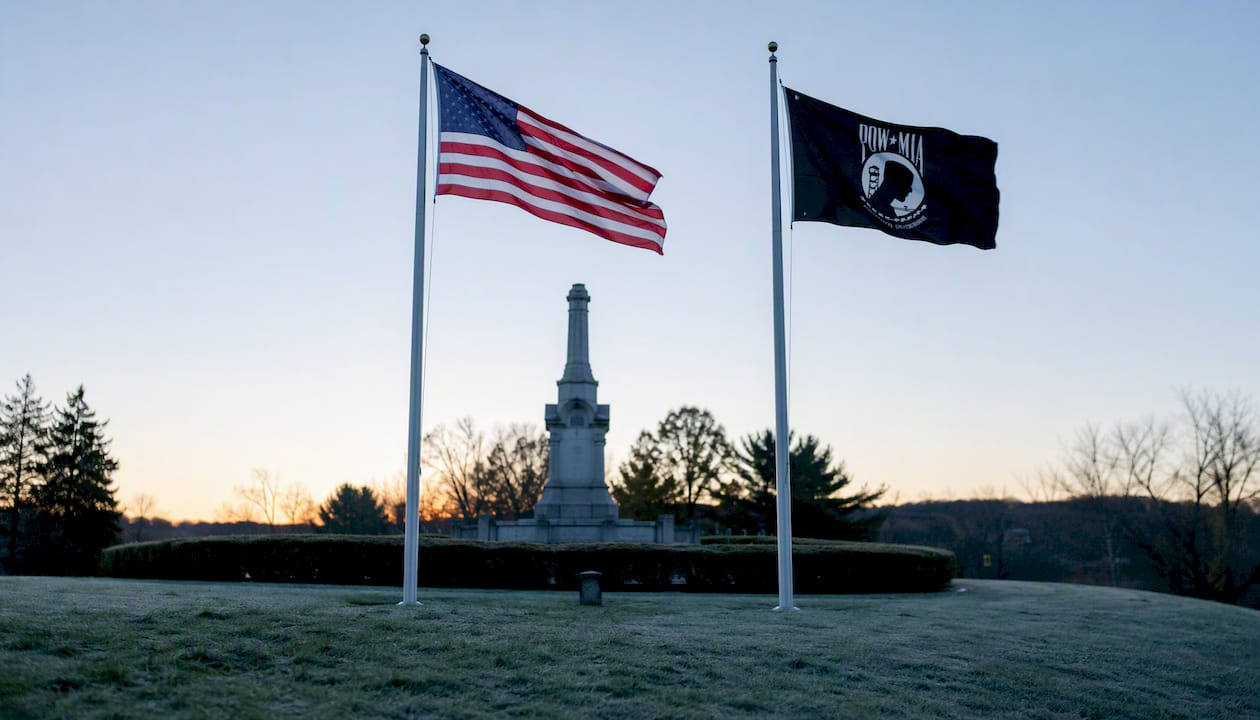
Beyond federal buildings, the flag is a fixture at the Korean War Veterans Memorial and the Vietnam Veterans Memorial in Washington, D.C., at American Legion and VFW posts nationwide, and at state capitol buildings in most states. National POW/MIA Recognition Day, observed annually on the third Friday of September, produces the highest concentration of coordinated public displays each year.
Grassroots display is equally significant. Private residences, community organizations, and local veteran groups fly the flag year-round. That informal visibility is not governed by the same federal rules that apply to government buildings, but it carries the same symbolic weight: a public acknowledgment that the accounting is not complete. The flag’s presence in these everyday contexts keeps the issue visible in communities where formal federal observance alone would not reach.
How to reproduce the POW/MIA emblem respectfully in apparel and products
The flag’s early history includes a detail that shapes commercial use today: the original design was not copyrighted. That decision was intentional — the National League of Families wanted the symbol to spread. The result is that many commercial variants exist, ranging from faithful reproductions to significantly altered versions that change colors, reverse the letter order, or modify the imagery.
For designers, manufacturers, and consumers, the practical guidance breaks down clearly:
- Use the official design elements. The core components — the captivity silhouette, watch tower, barbed wire, “POW/MIA” in the correct order, and the motto “YOU ARE NOT FORGOTTEN” — should remain intact. Altering the motto or reversing the letter order to “MIA/POW” changes the recognized emblem and can cause confusion about authenticity.
- Be cautious with color changes. The black-and-white design is the recognized standard. Color inversions or additions may be acceptable in some artistic contexts, but they should not be presented as the official emblem.
- Avoid commercial misuse. Using the emblem on novelty items, humorous products, or contexts that undercut its solemn meaning conflicts with the symbol’s purpose and the expectations of veteran and family communities.
- For formal or ceremonial use, source official flags. GSA purchasing channels and the National League of Families are the appropriate sources for flags used at ceremonies, government events, or formal veteran organization activities.
- Consider a proceeds component. Apparel that incorporates POW/MIA imagery carries an implicit claim of solidarity with veteran and family communities. Directing a share of proceeds to a POW/MIA-focused nonprofit or veteran support organization backs that claim with action. Warbeardproject’s veteran nonprofit apparel partnerships model demonstrates how that approach works in practice.
Pro Tip: Before placing the POW/MIA emblem on a product, review the National League of Families’ own guidance on reproduction. A brief product-page note explaining the emblem’s meaning and your brand’s connection to veteran causes builds credibility with the audience most likely to buy and most likely to notice if the context is wrong. For additional guidance on respectful placement and tone, Warbeardproject’s American flag in veteran apparel article covers the same principles applied to related imagery.
The trademark and copyright situation is straightforward: the original emblem is not protected by copyright, but the National League of Families retains significant moral authority over its use. Respecting League guidance and engaging with veteran family communities before launching POW/MIA-themed products is the practical standard, not just the ethical one.
Common myths and accurate answers about the POW/MIA flag
Several persistent misunderstandings circulate about the flag’s status and meaning. The corrections are direct:
-
Myth: The POW/MIA flag is an official U.S. government flag. Fact: The flag originated with the National League of Families, a private nonprofit. It has been designated by federal statute as a national symbol, but it is not a government-designed or government-issued flag in the same category as the U.S. flag or military branch flags.
-
Myth: The silhouette proves that American POWs are still alive in Southeast Asia. Fact: The silhouette represents captivity and the unresolved status of those unaccounted for. It is a symbolic image, not an evidentiary claim. The statute’s language — “still prisoner, missing, and unaccounted for” — reflects the unresolved accounting obligation, not confirmed live-captive intelligence.
-
Myth: Color or order changes (e.g., “MIA/POW” instead of “POW/MIA”) don’t affect the symbol’s meaning. Fact: The Institute of Heraldry notes that many alterations exist, but the core design elements define the recognized emblem. Reversing the letter order or significantly altering the imagery produces a variant, not the official symbol.
-
“Is it okay to fly the POW/MIA flag?” Yes. Private citizens may display the flag on residential or personal property without restriction. There is no federal prohibition on private display, and doing so is widely regarded as a respectful act of remembrance.
-
“What is the black flag under the American flag?” That is the POW/MIA flag. Its black background and white emblem make it visually distinct from all other flags commonly flown in the United States. When you see it below the U.S. flag on a single pole, it is following the correct order of precedence.
-
“Is it an official U.S. flag?” Not in the sense of being government-designed or government-issued. It is a privately originated symbol that has been formally designated by Congress as a national symbol under 36 U.S.C. § 902.
Why the POW/MIA emblem still carries weight today
Most national symbols drift toward decoration over time. The POW/MIA emblem has not, and the reason is structural rather than sentimental.
The 2019 expansion of display requirements was not a ceremonial gesture. Congress mandated that the flag fly every day the U.S. flag is displayed at covered federal properties — post offices, VA medical centers, the Capitol, the White House. That decision keeps the symbol in daily public view rather than reserving it for annual observances. Visibility is accountability made visible.
The flag’s origin from family advocacy also matters for how it reads today. Because the motto “YOU ARE NOT FORGOTTEN” came from families speaking to other families, not from a government agency speaking to the public, it carries a different kind of authority. It is a community’s promise, backed by statute, renewed every day the flag goes up.
For veterans, family members, and anyone who works with veteran communities, understanding the distinction between the flag as a memorial image and the flag as a legal accountability instrument changes how the symbol functions. It is not a tribute to the past. It is a standing demand on the present. Warbeardproject’s work connecting veteran brotherhood symbols to community identity reflects the same principle: symbols that carry real weight do so because real communities have invested real meaning in them, and that investment does not expire.
Sources
The following primary sources are the correct references for anyone citing the POW/MIA symbol’s meaning, legal status, or display requirements:
- Prisoner of War / Missing in Action Flag
- PLAW-116publ67 (National POW/MIA Flag Act)
- The POW/MIA Flag (VA)
- History of the POW/MIA Flag
- History of the POW/MIA Flag (NPS - Andersonville)