

Punisher Skull Meaning: Origins, Military Use, and Controversy
The Punisher skull today most often signals vigilante toughness and has become a contested emblem used by segments of the U.S. military, law enforcement, and far-right groups. Its meaning depends almost entirely on who displays it and in what context.
- Comic origin: A chest emblem for Marvel antihero Frank Castle, first published in 1974, designed to signal threat and hunter identity.
- Military use: Spray-painted on vehicles and gear by SEAL Team 3 in Fallujah during the Iraq War; spread across U.S. forces as a unit identity marker.
- Law enforcement and political adoption: Worn on police cruisers, body armor, and protest gear; later adopted by far-right actors, which sharpened public controversy.
- Key nuance: The skull’s original comic meaning (a vigilante operating outside institutional authority) directly conflicts with its use by institutional actors like police, a contradiction the symbol’s own creator has called out publicly.
Key Takeaways
The Punisher skull’s meaning has shifted from a comic-book vigilante emblem to a contested real-world symbol whose significance depends on who displays it, where, and alongside what other markers.
| Point | Details |
|---|---|
| Comic origin, 1974 | Created by Gerry Conway, John Romita Sr., and Ross Andru for The Amazing Spider-Man #129 as a vigilante warning symbol. |
| Military adoption | SEAL Team 3 and Chris Kyle spread the skull in Fallujah; it became a unit identity and psychological tactic marker across U.S. forces. |
| Creator rejection | Conway raised approximately $77,000 for Black Lives Matter Los Angeles through Skulls for Justice, directly opposing police and militia use. |
| Marvel’s redesign | Marvel debuted an oni-motif replacement in 2021–22 and filed a trademark for it; the original skull remains legally unprotected. |
| Context determines meaning | Who displays the skull, in what setting, and alongside what other symbols determines its practical meaning in any given instance. |
Table of Contents
- What is the Punisher skull meaning and where did it originate?
- How historical skull imagery shapes how people read the Punisher emblem
- How the U.S. military adopted the Punisher skull after 2001
- How police and political groups changed the symbol’s public meaning
- How Gerry Conway and Marvel responded to the symbol’s misuse
- What scholars and ethicists say about contested symbol meaning
- How to read the Punisher skull when you encounter it in real life
- What veterans actually think about the Punisher skull
- The Punisher skull is a symbol that indicts its own misuse
- Sources
What is the Punisher skull meaning and where did it originate?
The Punisher skull first appeared as the chest emblem of Frank Castle in The Amazing Spider-Man #129, published in February 1974. Three creators built the character: writer Gerry Conway, penciler John Romita Sr., and artist Ross Andru.
- Frank Castle / The Punisher: A former U.S. Marine whose family was killed by organized crime. He operates as a vigilante, outside the law, using lethal force.
- The skull’s original function: A deliberate warning to criminals. In-universe, it served as a target drawn on his chest to draw enemy fire away from vital organs, and as a psychological threat.
- Creator intent: Conway conceived the Punisher as a critique of vigilantism, not a celebration of it. The character was meant to be morally complicated, not a hero to emulate.
The emblem’s design is stark: a large white skull with elongated teeth on a black field, commonly produced on durable Hat Foundry UV Printed Gang Patches that demonstrate how such imagery spreads through merch channels. That visual simplicity made it easy to reproduce on patches, stencils, and gear, which accelerated its spread far beyond the comic page.
How historical skull imagery shapes how people read the Punisher emblem
The Punisher skull does not exist in a visual vacuum. Skull motifs have carried military and death-related meaning for centuries, and that history shapes how different audiences interpret the emblem today.
- The Totenkopf (“death’s head”): Originally used by Prussian cavalry units in the 18th century as a symbol of fearlessness in the face of death. The same motif was later adopted by SS units in Nazi Germany, which permanently attached a layer of extremist association to certain skull designs in the Western context.
- General skull symbolism: Across cultures, skulls signal mortality, danger, and deterrence. Pirates used them on flags to trigger surrender. Militaries have used them to mark elite or feared units.
- Why antecedents matter: When the Punisher skull appears alongside other extremist insignia, the Totenkopf lineage becomes part of how observers decode it. On its own, in a comic-book context, that lineage is largely invisible to most viewers.
Context is the operative variable. The same skull design reads differently on a Marvel trade paperback, a Navy SEAL’s kit bag, and a protest sign. Acknowledging the Totenkopf connection is not an accusation; it is a factual part of the symbol’s visual genealogy.
How the U.S. military adopted the Punisher skull after 2001
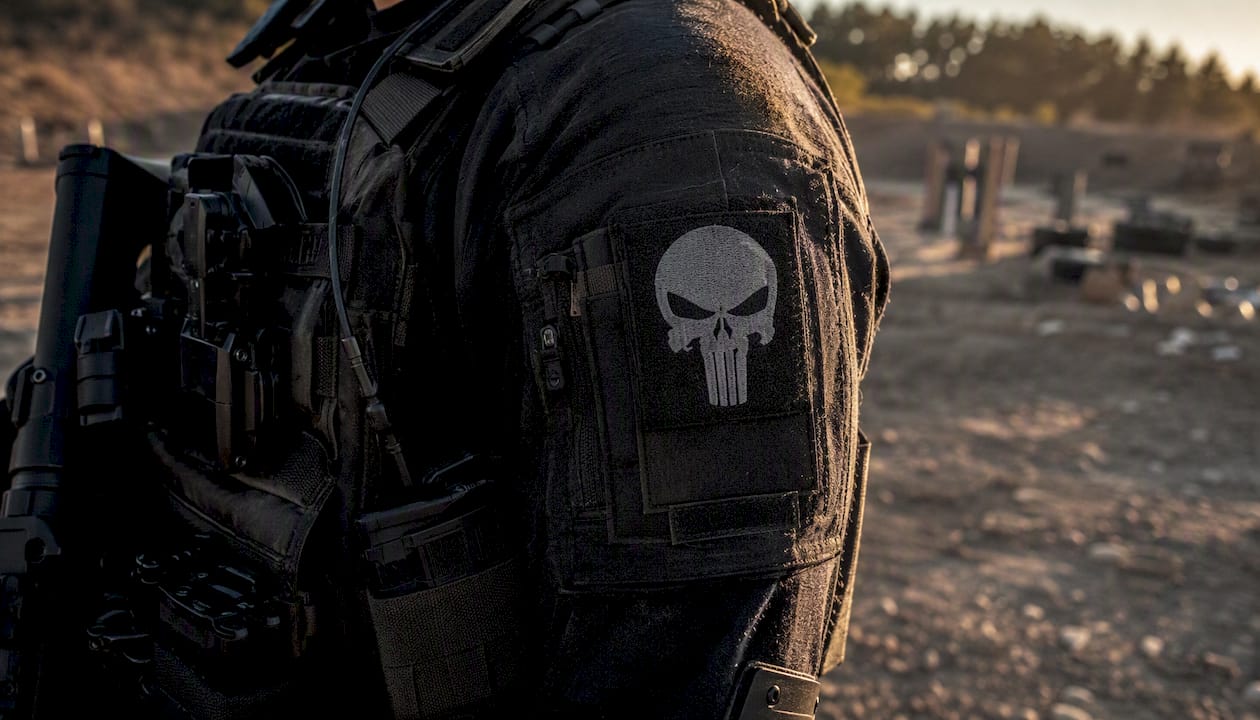
The symbol’s prominence in U.S. military culture grew sharply during the Iraq War. According to War History Online, SEAL Team 3 members, including Chris Kyle, began spray-painting the skull on vehicles, gear, and buildings in Fallujah in the mid-2000s.
- Timeline: Early adoption appears around 2003–2006, concentrated in special operations units operating in Iraq and Afghanistan.
- Chris Kyle’s rationale: Kyle described the skull as a psychological tactic, a signal to insurgents that his unit was operating in the area. It functioned as a unit identity marker and a deterrence tool simultaneously.
- Spread: After SEAL Team 3’s high-profile use, the emblem spread to other U.S. units, then to Iraqi security forces trained by American advisors, and eventually to domestic law enforcement.
The 99% Invisible analysis of the skull’s military adoption frames it around a tactical, mission-focused mindset. Inside high-stress operational environments, imagery that signals “no mercy” aligns with the psychological demands placed on operators. That framing helps explain the appeal without endorsing the downstream consequences. The symbol was not adopted because service members were comic book fans. It was adopted because it communicated something specific about operational identity that unit patches and official insignia could not.
How police and political groups changed the symbol’s public meaning
Law enforcement adoption of the Punisher skull became publicly visible during the 2010s and accelerated around 2020. Polygon’s reporting documents how police departments, individual officers, and political actors adopted the emblem, generating significant public controversy.
- Police use: Officers displayed the skull on patrol vehicles, body armor, challenge coins, and social media profiles. Some departments issued informal warnings after public complaints; few enacted formal bans.
- Political and far-right adoption: The skull appeared at rallies, on militia gear, and during the January 6, 2021 Capitol breach, worn by participants alongside other extremist insignia.
- Rationales offered by supporters: Solidarity with military culture, a signal of toughness, and identification with the Punisher’s “no-nonsense” approach to crime.
- Counterarguments from critics: A police officer wearing a symbol of a character who operates outside the law sends a direct message about their relationship to institutional authority and legal constraints. Critics argue it signals willingness to operate outside due process, which is precisely the opposite of what law enforcement accountability requires.
The core tension is structural. The Punisher is, by design, a character who rejects the legitimacy of the legal system. For an officer sworn to uphold that system to wear his emblem is a contradiction that critics argue is not incidental.
How Gerry Conway and Marvel responded to the symbol’s misuse
Gerry Conway’s response to law enforcement and militia use of the skull has been direct and documented. Forbes reported that Conway found such usage “enraging and embarrassing” and wanted to deny police and militia the opportunity to use the Punisher as a symbol of oppression.
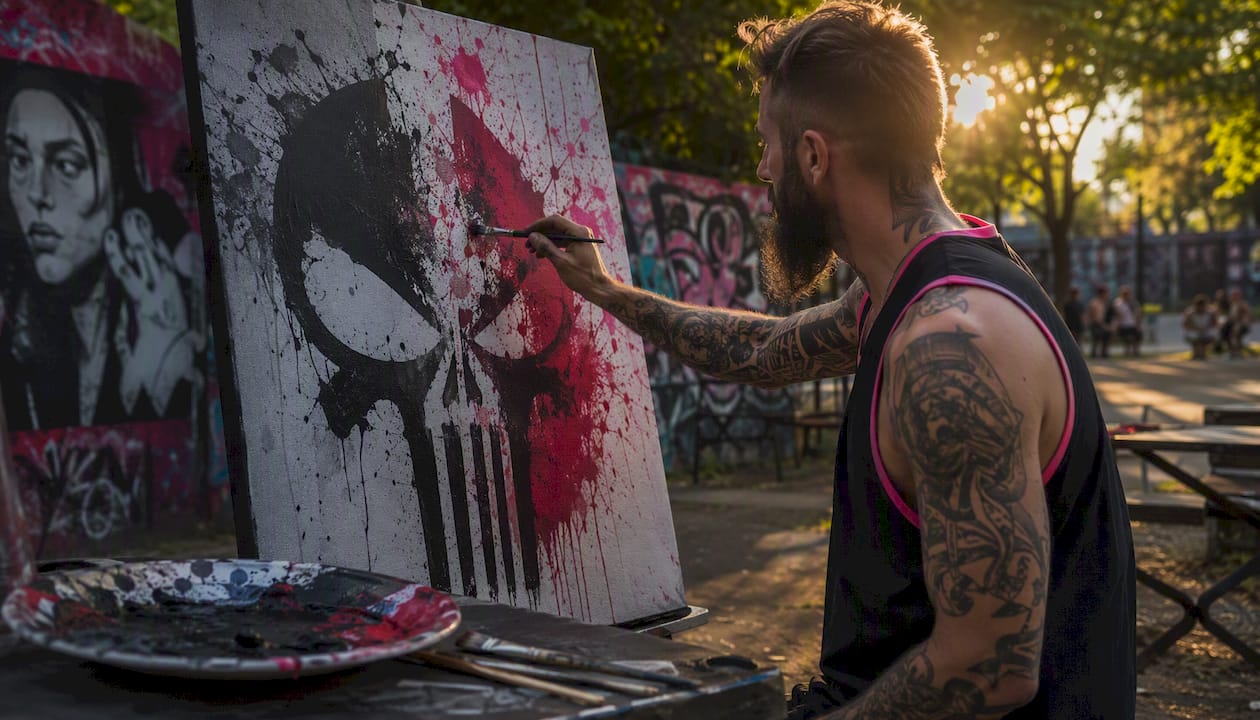
Conway launched the Skulls for Justice campaign in 2020, partnering with artists to sell redesigned skull merchandise and donate proceeds to Black Lives Matter Los Angeles. The campaign raised approximately $45,000 in its first two weeks and ultimately around $77,000 total.
Marvel’s corporate response came in 2021–22. The publisher debuted a redesigned Punisher logo, replacing the classic skull with a stylized oni motif in select publications. Marvel also filed a trademark application for the replacement design. Fan reactions were mixed: some readers welcomed the change as a meaningful break from a compromised symbol; others criticized it as a reactive corporate decision that would not affect real-world use.
The trademark situation constrains enforcement. The original Punisher skull is not a registered trademark, which means Marvel and Disney have limited legal tools to block unauthorized commercial use of the classic design. Trademarking the new oni variant protects that design going forward but does nothing about the millions of existing skull products already in circulation.
Pro Tip: If you are a veteran-owned brand considering skull imagery in your product line, check current USPTO filings for the specific design you plan to use. The classic Punisher skull remains legally unprotected, but derivative designs may carry different status.
What scholars and ethicists say about contested symbol meaning
The academic framework most useful for understanding the Punisher skull’s shifting meaning is “meaning-as-use,” drawn from Wittgenstein’s philosophy of language. Applied to symbols, the argument is straightforward: a symbol means what the community using it treats it as meaning, and that meaning changes as the community of users changes.
- Pro-use arguments (defenders): The skull signals unit solidarity, operational seriousness, and camaraderie. For many veterans, it carries no political content. It is a morale marker, not an ideology.
- Critical arguments: When a symbol is consistently adopted by actors who share a specific ideological orientation (rejection of institutional accountability), that pattern becomes part of the symbol’s meaning regardless of individual intent. Observers cannot read intent; they read context.
- Institutional implications: Several police departments have issued guidance discouraging the skull after public pressure. The 99% Invisible episode on the symbol notes that the ethical valence inside and outside the armed forces differs significantly, and that what reads as unit pride in a combat context reads differently on a domestic law enforcement officer.
The practical takeaway from the meaning-as-use framework is that individual intent does not fully determine social meaning. A veteran who wears the skull as a personal morale symbol is not automatically endorsing its far-right uses. But the symbol now carries those associations in public contexts, and that is a factual condition, not an accusation.
How to read the Punisher skull when you encounter it in real life
Context determines meaning. These cues help you assess what a specific display of the emblem likely signals:
- Who is displaying it: A veteran’s personal gear, a comic convention attendee, and a militia member at a political rally are three different contexts with three different probable meanings.
- Accompanying symbols: The skull displayed alongside official military insignia reads differently than the same skull displayed with extremist patches or political slogans.
- Setting: On a range bag at a shooting competition, it is almost certainly a morale or pop-culture reference. On a police cruiser during a protest, it carries institutional weight and sends a message about the officer’s self-conception.
- Official insignia: When the skull appears on official law enforcement equipment (body armor, vehicles, uniforms), it has moved from personal expression to institutional signaling.
For civilians: Document what you see if you believe it is being used in an official capacity that concerns you. Photograph the context, not just the symbol. Report to the relevant oversight body (police civilian review boards, department internal affairs) rather than escalating directly.
For employers and community organizations: A clear policy on personal insignia in professional settings is the most defensible position. The policy should address all non-official symbols, not single out one design.
Pro Tip: Veteran-led organizations approaching symbolic reuse often distinguish between personal expression (acceptable) and institutional display (subject to policy). That distinction is the most practical line to draw.
For guidance on how military tradition shapes apparel choices, Warbeardproject’s editorial coverage offers context grounded in the veteran community’s own norms.
What veterans actually think about the Punisher skull
Veteran opinion on the skull is not monolithic. The divide generally runs along lines of generation, branch, and operational experience.
- Those who embrace it: Often special operations veterans or infantry veterans who encountered the symbol in combat contexts. For them, it represents unit identity, operational intensity, and camaraderie. The political controversy feels external to their original experience of the symbol.
- Those who push back: Veterans who see the skull’s adoption by far-right groups and some police as a corruption of military culture. They argue the symbol now carries associations that dishonor the service it was meant to represent.
- The Skulls for Justice model: Conway’s campaign demonstrated that creator-led reclaiming efforts, combining art, fundraising, and public messaging, can shift a symbol’s associations. The $77,000 raised for Black Lives Matter Los Angeles was a concrete outcome, not just a statement.
Understanding why veterans embrace brotherhood symbols requires engaging with the specific social functions those symbols serve: identity, solidarity, and shared experience under pressure. The Punisher skull served those functions effectively in military contexts. The problem is that effective symbols do not stay contained.
Warbeardproject approaches skull and military imagery with that tension in mind. The brand’s mission-driven collections connect visual identity to veteran support programs, keeping the link between imagery and community accountability explicit. For brands operating in this space, authenticity matters to service members in ways that go beyond design choices.
The most defensible use of contested military imagery is one where the brand’s actions, not just its aesthetics, demonstrate alignment with the community it claims to represent.
The Punisher skull is a symbol that indicts its own misuse
The conventional take on the Punisher skull controversy frames it as a clash between free expression and public sensitivity. That framing misses the actual problem.
The Punisher was designed by Gerry Conway as a character who represents the failure of institutional justice, not its enforcement. The skull is the emblem of someone who operates because the system has collapsed. When a police officer, who is the system, wears that emblem, the message is not ambiguous. It is a direct statement about how that officer conceives of their own authority: as personal and extralegal, not institutional and accountable.
That is not a reading critics are imposing on the symbol. It is the reading the symbol was built to produce.
What gets underestimated in most coverage is how clearly Conway understood this from the beginning. His objection to police use is not squeamishness about violence in fiction. It is a precise critique: the Punisher’s entire premise is that the law has failed. Wearing his skull while enforcing the law is a contradiction that the wearer either does not recognize or does not care about. Neither option is reassuring.
The meaning-as-use framework is real and useful. Symbols do shift. But shifts require sustained, organized effort, not just individual intent. Conway’s Skulls for Justice campaign showed one viable path. Marvel’s redesign showed another. Whether either effort will displace the skull’s current associations in the contexts where they matter most, law enforcement and political organizing, remains an open question.
For veterans who wear the skull as a personal morale marker, the practical question is whether the symbol still communicates what they intend it to, or whether it now communicates something else entirely to the people who see it.
Sources
- Punisher skull
- Punisher Skull Meaning: What Does the Punisher Logo Mean in the US Military? | War History Online
- The Creator Of ‘The Punisher’ Wants To Reclaim The Iconic Skull From Police And Fringe Admirers
- Late Punisher creator Gerry Conway legacy is rejecting cops’ use of skull symbol
- The Punisher skull